Sunday, April 12, 2026
Sunset and rise : my first consecutive witnessing
Recently, I witnessed sunset in the evening and sunrise the very next morning. A
first for me: two consecutive dates with the sun. (‘date’ pun intended)
It was during travels in Sri Lanka, in the temple and beach town of Trincomalee, or Tiri-kone-malai (sacred-kone-hill) as multiple elder Tamilians referred to it. Trincomalee’s most famous tourist draws are firstly the dramatically located ‘Koneswaram temple’ at the top of a hill (thus the sacred-kone-hill) which tapers dramatically as a cliff into the ocean, and secondly the sands of Uppuveli beach. Aptly enough, I witnessed the sunset from the commanding heights of the Koneswaram hill, and sunrise from the soft sands of the Uppuveli beach.
Apart from the vibrant yellow-orange sun, we also observed and dallied with other natural wonders, vibrant in their own ways. During sunset, peacocks came out in large numbers – atop a tree, hopping on the road, astride a large gate; resplendent in their comically large, blue-green vibrancy. Monkeys hopping quickly from HQ (trunk) to different branch offices, like honest civil servants. Deer on a lazy graze. During sunrise, we had for company some stray dogs which called the beach home; friendly lot, drawing pets and strokes from us. Shortly after sunrise- kilometers into the ocean- dolphins jumping acrobatically near our speedboat (relieving our anxieties of a wild-goose-chase endeavor)
During set and rise, right above the horizon there was a narrow band of clouds. So, the sun did not sink into the horizon- it sank behind the clouds. With the sun behind them, the clouds resembled a striking carboard cut-out: grey body, with luminous orange borders. The cut-out was against a stirring background: the customary evocative set-rise colors bleeding into the sky, palette of yellow-orange-pink-grey-blue, shades transitioning smoothly into one another. Amid all the varieties of transitions life throws at us (eg: attacking transitions in football, career transitions), I’d call this one the mother of all transitions. Atleast on the parameter of ‘smoothness’. Viewing this transition always evokes in me a desire to coat a layer of water on thick paper, and unleash via paintbrush a depiction of the scene. I did it once with pencil colours, after observing sunset from an airplane window. The resulting creation I put up for a year or so on my wall in Mumbai. Quite neat to have a sunset-view window in your bedroom all the time, eh? Just like it popped up on my awareness during the flight that one random evening– set-rise viewings are quite easily accessible. For me, every evening from my west-facing balcony at home or from the high floor (15th) in my office. It’s my own state of mind which decides whether I stop to see it. Artist Scott Polach’s installation, ‘Applause Encouraged’, was organized at Cabrillo National Monument in San Diego. At a cliff (similar to Kona-Malai), eight participants are ushered on to chairs for 45 minutes in a cordoned-off area, asked to turn off their phones. They view the sunset scene unfolding in front of them. At last light, the participants are offered refreshments.
The sunset in Trinco had more colors than the sunrise. Pink was missing in the sunrise. Perhaps it was due to the clouds, which were more plentiful in the evening. I did not remember this aspect about clouds’ evening plentitude- it’s just that while I write, I look at the picture on the phone. Which reminds me- phones nowadays do these tricks wherein the picture on the phone looks prettier than the one in front of one’s eyes, a scenario that comes about especially in these grand nature pictures. Begs the question: what does ‘seeing’ something mean? When I go birdwatching, I do feel a purer sense of ‘seeing’ when I see through the binoculars than through the 10X optical zoom of the phone camera. Although the binoculars’ zoom is lower, binoculars are cumbersome, and harder to lock on target.
During both rise and set, the sun's shimmering reflection on the ocean waters also left an impression. After set, descending from the malai for dinner, I got another view of the sunset from an old disused quay, next to the famous Dutch Bank cafe.
Observing and appreciating nature is a skill, consisting of a multiple sub-skills playing out at the same time. Mindfulness: the ability to focus on the sight, which unfolds at a pace often slower relative to other 21st century processes. Allowing lack of control: the unfolding event, and its pace, cannot be influenced: can’t pause, or increase speed to 1.5x speed, or scroll to next. For those fed on a steady diet of sporting movement: holding still pose without endorphin/adrenalin rush of bodily movement. Finding your own personal definition of ‘seeing’ : the balance between taking pictures on the phone, and observing the ephemeral with plain old eyes; just the retina, not a retina display. As the legendary photographer played by Sean Penn memorably says upon spotting the elusive Snow Leopard in ‘Secret Life of Walter Mitty’: ‘When I like moment, I mean me personally, I don’t like the distraction of a camera’. Ignoring the variability and discomfort of the ‘elements’: weather is not ‘air-conditioned’. That set-rise, I observed that the sunrise was much warmer than the sunset, and a few minutes of the rise I was scrambling back into the A/C room. And finally, savoring the after-taste : reflecting upon it in one’s own personal way – viewing the picture, writing a blog post.
Like any skill, it improves with practice, and decays with disuse. Upon repetition, a repository gets build, and comparing with past observations adds to the experience.
Hope I deploy and build upon this skill, and you do too.
END
Set from the Malai
 Set seen from quay near Dutch Bank Cafe
 Rise and Shine on Uppuveli beach .

It was during travels in Sri Lanka, in the temple and beach town of Trincomalee, or Tiri-kone-malai (sacred-kone-hill) as multiple elder Tamilians referred to it. Trincomalee’s most famous tourist draws are firstly the dramatically located ‘Koneswaram temple’ at the top of a hill (thus the sacred-kone-hill) which tapers dramatically as a cliff into the ocean, and secondly the sands of Uppuveli beach. Aptly enough, I witnessed the sunset from the commanding heights of the Koneswaram hill, and sunrise from the soft sands of the Uppuveli beach.
Apart from the vibrant yellow-orange sun, we also observed and dallied with other natural wonders, vibrant in their own ways. During sunset, peacocks came out in large numbers – atop a tree, hopping on the road, astride a large gate; resplendent in their comically large, blue-green vibrancy. Monkeys hopping quickly from HQ (trunk) to different branch offices, like honest civil servants. Deer on a lazy graze. During sunrise, we had for company some stray dogs which called the beach home; friendly lot, drawing pets and strokes from us. Shortly after sunrise- kilometers into the ocean- dolphins jumping acrobatically near our speedboat (relieving our anxieties of a wild-goose-chase endeavor)
During set and rise, right above the horizon there was a narrow band of clouds. So, the sun did not sink into the horizon- it sank behind the clouds. With the sun behind them, the clouds resembled a striking carboard cut-out: grey body, with luminous orange borders. The cut-out was against a stirring background: the customary evocative set-rise colors bleeding into the sky, palette of yellow-orange-pink-grey-blue, shades transitioning smoothly into one another. Amid all the varieties of transitions life throws at us (eg: attacking transitions in football, career transitions), I’d call this one the mother of all transitions. Atleast on the parameter of ‘smoothness’. Viewing this transition always evokes in me a desire to coat a layer of water on thick paper, and unleash via paintbrush a depiction of the scene. I did it once with pencil colours, after observing sunset from an airplane window. The resulting creation I put up for a year or so on my wall in Mumbai. Quite neat to have a sunset-view window in your bedroom all the time, eh? Just like it popped up on my awareness during the flight that one random evening– set-rise viewings are quite easily accessible. For me, every evening from my west-facing balcony at home or from the high floor (15th) in my office. It’s my own state of mind which decides whether I stop to see it. Artist Scott Polach’s installation, ‘Applause Encouraged’, was organized at Cabrillo National Monument in San Diego. At a cliff (similar to Kona-Malai), eight participants are ushered on to chairs for 45 minutes in a cordoned-off area, asked to turn off their phones. They view the sunset scene unfolding in front of them. At last light, the participants are offered refreshments.
The sunset in Trinco had more colors than the sunrise. Pink was missing in the sunrise. Perhaps it was due to the clouds, which were more plentiful in the evening. I did not remember this aspect about clouds’ evening plentitude- it’s just that while I write, I look at the picture on the phone. Which reminds me- phones nowadays do these tricks wherein the picture on the phone looks prettier than the one in front of one’s eyes, a scenario that comes about especially in these grand nature pictures. Begs the question: what does ‘seeing’ something mean? When I go birdwatching, I do feel a purer sense of ‘seeing’ when I see through the binoculars than through the 10X optical zoom of the phone camera. Although the binoculars’ zoom is lower, binoculars are cumbersome, and harder to lock on target.
During both rise and set, the sun's shimmering reflection on the ocean waters also left an impression. After set, descending from the malai for dinner, I got another view of the sunset from an old disused quay, next to the famous Dutch Bank cafe.
Observing and appreciating nature is a skill, consisting of a multiple sub-skills playing out at the same time. Mindfulness: the ability to focus on the sight, which unfolds at a pace often slower relative to other 21st century processes. Allowing lack of control: the unfolding event, and its pace, cannot be influenced: can’t pause, or increase speed to 1.5x speed, or scroll to next. For those fed on a steady diet of sporting movement: holding still pose without endorphin/adrenalin rush of bodily movement. Finding your own personal definition of ‘seeing’ : the balance between taking pictures on the phone, and observing the ephemeral with plain old eyes; just the retina, not a retina display. As the legendary photographer played by Sean Penn memorably says upon spotting the elusive Snow Leopard in ‘Secret Life of Walter Mitty’: ‘When I like moment, I mean me personally, I don’t like the distraction of a camera’. Ignoring the variability and discomfort of the ‘elements’: weather is not ‘air-conditioned’. That set-rise, I observed that the sunrise was much warmer than the sunset, and a few minutes of the rise I was scrambling back into the A/C room. And finally, savoring the after-taste : reflecting upon it in one’s own personal way – viewing the picture, writing a blog post.
Like any skill, it improves with practice, and decays with disuse. Upon repetition, a repository gets build, and comparing with past observations adds to the experience.
Hope I deploy and build upon this skill, and you do too.
END
Set from the Malai


Labels: Musings


Sunday, March 01, 2026
Dots connecting backwards and creating a whole non-dual picture
Two recent occassions created for me evocative 'join the dots backwards' moments.
I meditate using an app called 'The Way' which is a series of progressive meditation sessions painstakingly created by Zen Master Henry Shukman. I've meditated 1931 minutes so far in a little over a year - something that I'm proud of. 'The Way' is organized in the form of a hike; the biggest level of organization is 'Trails' such as Mindfulness, Support and Flow; each trail has 6-7 'Retreats' on specific sub-topics, and within each retreat there are 6-7 meditation sessions. Trails -> Retreats -> Sessions. Retreat makes it sound like welcoming base camps on the hike, while the session itself is the exploration of the areas around the base camp.
Last week, I was in the middle of the Trail called 'Wild World of Koans'. Koans are pithy and sometimes confusing sayings which enable and implore reflections on reality and the human condition. In the trail, the first retreat is on the Koan 'Not knowing is intimate'. Once we define something, we lose some sense of wonder around it. We relegate it to the familiar. Familiary breeds contempt, no?
It seems a different way to state one of my favorite insights from Indian philosopher J Krishnamurti, which I came across a year ago. He said: 'The day you teach the child the name of the bird, the child will never see that bird again'.
Bingo, it's the same idea! J Krishnamurti's insight parallels the one from Henry Shukman in the app. I love these moments, when some insight that I resonated with deeply, comes at me differently in another context and another time.
In the same retreat, one of the sessions was a different perspective of 'Not knowing is intimate'; it was called: 'Let the wind carry you'. I reflected, one can also view both sayings, 'not knowing...' and 'let the wind..' as exhortations to trust others: by allowing them to take you somewhere, you repose intimate trust in them.
The day after reflecting on 'Let the wind carry you', NP took A and me to an event by an NGO called 'Reap Benefits' called 'Solvecon'. We did not know the agenda of the event, we just went along. We prepared to give an AMA talk to young adults, but it got cancelled. A and I instead roamed the stalls, learning more about a voluntary organization called 'Broseph foundation' which is doing great work to make urban bengaluru better for its citizens. I felt happy that such an org existed, doing such great work for the common man. Through the vist, I also got to see 'PESIT' college- one of the famous colleges of BLR I'd heard about but never been to.
We trusted NP and went along, without knowing really what would happen; and when the original plan got cancelled, we let the wind carry us. And had a good time. Yet again, the same perspective played out in a different context, this time by theory meeting practice. Dots joining backwards, as Steve Jobs referred to it, produce moments of beauty.
In meditation and and spirituality, there is a lot of talk of 'non duality', referring to how meditation journeys instill the feeling that a person is physically not separate from the society, the earth, the elements and cosmos. It often comes out in sports, where you experience 'aha moments' of not being just an individual, but a unit, a team, working together towards the goal of victory.
I always thought of this non-duality manifesting itself in physical terms : how the physical identity of 'I' fades into background. There's something to be said about 'non duality' of insight and experience. Different ideas tying together, dots joining backwards. Like in the two instances mentioned in this post: 'Not knowing is intimate' linking to 'The name of the bird' and 'Let the wind carry you' linking to the Reap benefits visit. So, good ol' non-duality, showed up last week for me, in another way. Non-duality of insight and experience.
I meditate using an app called 'The Way' which is a series of progressive meditation sessions painstakingly created by Zen Master Henry Shukman. I've meditated 1931 minutes so far in a little over a year - something that I'm proud of. 'The Way' is organized in the form of a hike; the biggest level of organization is 'Trails' such as Mindfulness, Support and Flow; each trail has 6-7 'Retreats' on specific sub-topics, and within each retreat there are 6-7 meditation sessions. Trails -> Retreats -> Sessions. Retreat makes it sound like welcoming base camps on the hike, while the session itself is the exploration of the areas around the base camp.
Last week, I was in the middle of the Trail called 'Wild World of Koans'. Koans are pithy and sometimes confusing sayings which enable and implore reflections on reality and the human condition. In the trail, the first retreat is on the Koan 'Not knowing is intimate'. Once we define something, we lose some sense of wonder around it. We relegate it to the familiar. Familiary breeds contempt, no?
It seems a different way to state one of my favorite insights from Indian philosopher J Krishnamurti, which I came across a year ago. He said: 'The day you teach the child the name of the bird, the child will never see that bird again'.
Bingo, it's the same idea! J Krishnamurti's insight parallels the one from Henry Shukman in the app. I love these moments, when some insight that I resonated with deeply, comes at me differently in another context and another time.
In the same retreat, one of the sessions was a different perspective of 'Not knowing is intimate'; it was called: 'Let the wind carry you'. I reflected, one can also view both sayings, 'not knowing...' and 'let the wind..' as exhortations to trust others: by allowing them to take you somewhere, you repose intimate trust in them.
The day after reflecting on 'Let the wind carry you', NP took A and me to an event by an NGO called 'Reap Benefits' called 'Solvecon'. We did not know the agenda of the event, we just went along. We prepared to give an AMA talk to young adults, but it got cancelled. A and I instead roamed the stalls, learning more about a voluntary organization called 'Broseph foundation' which is doing great work to make urban bengaluru better for its citizens. I felt happy that such an org existed, doing such great work for the common man. Through the vist, I also got to see 'PESIT' college- one of the famous colleges of BLR I'd heard about but never been to.
We trusted NP and went along, without knowing really what would happen; and when the original plan got cancelled, we let the wind carry us. And had a good time. Yet again, the same perspective played out in a different context, this time by theory meeting practice. Dots joining backwards, as Steve Jobs referred to it, produce moments of beauty.
In meditation and and spirituality, there is a lot of talk of 'non duality', referring to how meditation journeys instill the feeling that a person is physically not separate from the society, the earth, the elements and cosmos. It often comes out in sports, where you experience 'aha moments' of not being just an individual, but a unit, a team, working together towards the goal of victory.
I always thought of this non-duality manifesting itself in physical terms : how the physical identity of 'I' fades into background. There's something to be said about 'non duality' of insight and experience. Different ideas tying together, dots joining backwards. Like in the two instances mentioned in this post: 'Not knowing is intimate' linking to 'The name of the bird' and 'Let the wind carry you' linking to the Reap benefits visit. So, good ol' non-duality, showed up last week for me, in another way. Non-duality of insight and experience.
Labels: Musings
Sunday, October 18, 2020
"Life of Ram" : The song/video/lyrics is an artistic tour-de-force
I have sporadic barters with Bluestag (aka Rahul Reddy) on the subject of South Indian songs , the best takeaway of which was Kangal Irandaal till 1 year ago. 1 year ago, he suggested to me the Tamil song “Life of Ram” (here it is link) which I heard and enjoyed then, and have been giving it the odd listen on and off. Now RR knows nil Tamil while I know broken, so your ignorance of the language need not be reason to pause here.
Today, I went deep into the said song on Youtube. And came out astounded! It’s an artistic tour-de-force (called TDF hereon), I feel. There are 5 amazing aspects of this artistic TDF:
1) The music2) The lyrics3) The video4) The interplay between the music and the video5) The interplay between the lyrics and video
Let’s dive in.
The music? Thought it was lovely. Vocals are fabulous. The gentle guitar strumming at the start is pleasing. And the way the song seamlessly traverses the high and low pitches, and the rapid and slow speeds, is remarkable. In your first journey through the TDF, I suggest just focus on the music.
As for the lyrics, the youtube video itself displays the lyrics as captions surprisingly accurately, but I suggest don’t focus on the lyrics on the first run. After the first listen, go through the lyrics here: <link> . And that will help you truly soak in the lyrics independent of the song. My Tamil vocabulary is quite limited, so I don’t think knowledge Tamil is required to appreciate. I enjoyed the part about how one likes the sea after reaching the shore, and that today’s experiences will make sense tomorrow. The sentences below are really poetic in their alliteration, and rhyme, and I am guessing took some dexterity in Tamil vocabulary to compose:
Vagai Vagai Vazhgiren, Pagai Paagai Aagiren
Coming to the video, it’s a beautiful endorsement for India’s varying colors, sights and sounds, ranging from forests, seas, country side roads, wildlife, deserts, mountains, city scapes, etc. The video jumps from the contrasts of solitude in the jungle or desert, to the milling crowds of Kolkata. My least favorite part is the romanticization of pigeons because I believe pigeons are noisy pests. The product placement of Renault Duster is not annoying. Also, another hat tip to Reddy here, who himself owned a Duster (Terrano, which is just the same) long ago.
The song and video are interwoven beautifully. Some mesmerizing sequences:
1) Smooth flows: At 20:10, the song is slow and thoughtful and so is the man. At 2:13, the vocals pick up vigour and pace, and simultaneously the man plants his umbrella and purposefully strides out to the waters. at 2:20, when the song goes into “Ad a daaaaa”, the wave is shown flowing smoothly from top view and in a smooth gesture, the man scoops up some water. Fabulous.2) Emergence: At 3:25, the song is mellow. While the song hits a mini crescendo at 3:32, the man emerges from behind a dune, perched atop a camel. On the same theme, a little ahead, the vocals enter an ecstatic sequence, and we suddenly cut to a scene of the man soaking in a waterfall.3) Calmness: At 3:54, when the vocals become calm, the video zooms out, and the waterfall which displayed seconds earlier a frantic energy , is now seen to be calmly and slowly falling to the rocks in wave upon gentle wave.
The interplay between video and lyrics is the final element of the TDF. Some remarkable instances:
1) 2:16 – “The joy of a kitten’s caress”: the wave from the sea caresses the foot of the man.2) 2:19 – “I want to stroke everything I come across, beautifully”: the man bends down and caresses the wave.3) 3:11 – “With the wind flies the hawk”: The wind buffets the lonesome tent in which the man peeps out of4) 3:21 – “Like the rock that goes to the depths of the water” – we see the man falling fast through the dune.5) 3:27 – “Renouncing of sound”- the sound of the chaotic descent of the man through sand disappears as he surveys the surroundings.6) 3:34 – “Like the bird that rides on the bulls hump I will live on the earth”- the man is perched atop a camel and then quickly gets on the ground.7) 3:49 – “This moment envelops like a mother”: the waterfall gushes down and envelops a rock.
Urge you to go through the TDF in the same order as listed above, one by one. Would require 5 journeys through the TDF, which would be a half hour “immersing into the depths”, as the song itself urges.
On a side note, the above exposition on this song puts into practice some of the observational skills I’ve
learnt in the Creativity in Arts and Science course during MBA.
@RahulReddy: Am sure that if this song came out during undergrad, it would have got as many repeat plays on loud volume on your Altec Lansing, as Engel and In the End. Also, the man in the video does resemble you to some extent.
Sunday, April 12, 2020
Perils of hero worship in today's day and age
Imagine regular Rahul with a regular Role- 9-5 job at a technology company, comes back home to play tennis ball cricket with his 2 kids and friends, enjoying the game and being part of a cheerful crowd in his apartment complex. He is environmentally conscious, careful with water and plastic, and using public transport as much as possible. During the weekend, he participates in 2-3 hour discussions with Rotary club on sundry, small improvement projects - how to how to make the immediate colony greener (barely 1 square kilometer), and some charitable causes nearby. He also visits nearby parks with his wife and kids, where he goes for long walks and occasional boating on the lake. At the tech company, Rahul is part of an important project to make a software to enable Virtual 3D Holograms (like in Star Wars) - to make global virtual meetings more effective. Now make a country of 1 million Rahuls, and don't you have a happy and prosperous country?
Will there be a book written about Rahul? Never. He's no CEO, he's just a middling mid-level manager. Where is the drama? Regular, predictable life, nothing seemingly remarkable. No autobiography or movie about him, with a bombastic title - "Story of a Stud" (made that up), "Losing my virginity" (real), "Mah lyf mah rulez" (made that up). However, he's happy, and he's part of a decent bunch of people at work, and 1 Mn versions of him are working cohesively are taking the country towards sustainable prosperity.
My point is to warn against idolising 'heroes' before deep scrutiny. Today, I think there is a massive rise in non-fiction 'hero-worship' content. This is probably due to excellent data recording over the past 30-40 years such as digital storage and the powerful media. Globalization, and reach of the media via streaming and social, is magnifying the power of spreading these stories. Further, there is increasing scrutiny of factors behind world class performance, with books like Outliers offering a formula based on some individual successes. Note that I myself have consumed a lot of hero-worship content, and therefore, all my points below are not just sermonizing to the read but to myself, too.
There are three main issues I see that should lead one to be careful when worshipping heroes that modern media and society throw up. One, is Survivorship bias. Second, is the story that is told and the story that is not told. Last, is happiness quotient of their own selves.
Survivorship bias- classic fallacy- the very mix of traits that supposedly explained the success of this guy, could have led 99 people to failure, but we will not hear of those stories- we will hear only of this 1 guy. Therefore, adopting his traits would lead us towards a 99% chance of 'failure', however we define it. There's the standard finance test; in which there's 1000 people who randomly predict that the market in the year will go Up or Down. After 10 years, there will be 1 guy out of 1024 who predicted the market exactly (Up, Down, Up, Up, Up, Up, Down, Down, Down, Up) and Wall Street Investor will run a cover story on this guy and talk about various habits of his such as drinking Ragi Malt at 11 PM contributed to his stunning success. And completely ignore the 1023 others. All media, be it print or streaming, is built on stories; and humans love stories; and therefore temptation must be great to build a cover story on this 1-guy who got the call right for 10 consecutive years- what are his habits, beliefs, philosophies, and favorite coffee flavor.
Next is that there's the untold story behind the told story- success was only possible because of underhand or unsaid means not mentioned in the book or movie. I call this the Autobiography fallacy, because one might tend to avoid murky secrets or perhaps even suspected elements of luck in telling their story to the wider world, in order to not destroy one's own legacy. Elizabeth Holmes, after the success of Theranos which did blood tests on just a pin prick of blood, was the darling of media and was hailed as hero for women the world over. Netflix would have been close to releasing a mini series on her success and her methods the world over. I am sure girls in Silicon Valley copied her deep voice, her dressing, and her hairstyle, her ways. However, 3 years later, her world collapsed and her company and she was indicted of massive fraud (book review of Bad blood on this blog is here ) . Now Netflix would have quickly done an about-turn and released the series about the shocking fraud. Movie's under process - Bad Blood IMDB link is here . Further, as pointed out in Outliers, Bill Gates and Steve Jobs had immense lucky breaks - getting unprecedented access to a university computer at a young age- that gave them a huge early leap over others. No one knew about this, and for all their amazing traits mentioned in movies and biographies and copied by many, this lucky break might have been the most important reason. Their success therefore might have been despite these traits, due to their lucky early break, and not because of these traits. Further, there are numerous famous dubious stands which Steve Jobs has taken, which his biographer has not mentioned. One of which is- when he stole Mac's OS from Xerox, he said in 1996 "we have been shameless about stealing great ideas" (sic); but after Google launches Android, he said he would do Thermonuclear war on Android copying iOS (2 minute link here ). Also linked to this point is the fact that the company that these 'heroes' build, such as Nike or Apple, survive during the date of publishing of autobiography and said heroes hold a lot of stock of the company in their wealth. Therefore, there is no way that Phil Knight or Steve Jobs will reveal anything that will materially lower the company's share price.
Lastly, there's Van Gogh- VVG is obviously an immense professional success- his works have held the world in their thrall for 200+ years. I myself have dazzled by his works in the Van Gogh museum, a book on him and his paintings adorns my coffee table, and there's a review of Starry Night in this very blog right here ) There's also an analysis in the book Range about how the fact that he was unsuccessful in various vocations and those repeated quick failures 'trial and error' approach led him to hit upon big success in painting. However, the fact is, he was clinically depressed, realized that his paintings were a big hit only for the last 2 odd years, shot himself to kill, died a painful and lonely death, at the age of 35 odd. There's no posthumous joy from all the global adulation he is receiving till date. Will you be ok with this deal? Another fairly famous from the annals of biographies is Agassi's bio 'Open' - on how he absolutely hated Tennis and was very insecure for a very long time.
In conclusion, I am not saying- do not learn from heroes or do not annoint heroes. I will continue to read biographies and inspiring stories. How does one guard against this? Some thoughts follow, and they apply to me as much as to you. Firstly, better to wait for a bit before quickly anointing someone as a hero, because the closely guarded dark secrets behind the success might come out soon. Secondly, define one's own framework for personal success based on our starting position and our priorities. Thirdly, filter out survivorship bias and search carefully if there's some critical detail missing in the story and only then pick up traits or stories. More the data around it all, the better. I am reminded about how I went back to IIM B recently for a run, and I was speaking to a Professor Saurav Mukherjee about senior alum returning to campus and giving talks. He was skeptical and said that in such cases, people only talk about 'war stories', which he wanted to avoid, and that he wanted more of cases, with their data and rigour. War stories would probably be highly susceptible to Survivorship bias and Autobiography fallacy. Lastly, massive change and impact can be achieved by a group of 'normal' people with no superhuman powers, who work closely together in spirit of community and bonhomie. So instead of solely focusing on being a hero all by yourself like all the heroes in the book, one could perhaps also spend time on increasing co ordination and cohesion with community around.
Edit on Oct 18 2020: Extract from "The Four" - a masterly read in the tech-firm-bashing genre, by wise and got-my-hands-dirty-not-just-a-phD prof, Scott Galloway: "There are few better examples of what Pope Francis refers to as in unhealthy "idolatry of money" than our obsession with Steve Jobs. It is conventional wisdom that Steve Jobs put a "dent in the universe". No, he didn't. Steve Jobs, in my view, spat on the universe. People who get up every morning, get their kids dressed, get them to school, and have an irrational passion for their kids' well-being, dent the universe. The world needs more homes with engaged parents, not a better f*ing phone" While this paragraph is somewhat reductive in itself, and I feel Apple has done more than create just a phone, I do see the point and it echoes the theme of the post.
Will there be a book written about Rahul? Never. He's no CEO, he's just a middling mid-level manager. Where is the drama? Regular, predictable life, nothing seemingly remarkable. No autobiography or movie about him, with a bombastic title - "Story of a Stud" (made that up), "Losing my virginity" (real), "Mah lyf mah rulez" (made that up). However, he's happy, and he's part of a decent bunch of people at work, and 1 Mn versions of him are working cohesively are taking the country towards sustainable prosperity.
My point is to warn against idolising 'heroes' before deep scrutiny. Today, I think there is a massive rise in non-fiction 'hero-worship' content. This is probably due to excellent data recording over the past 30-40 years such as digital storage and the powerful media. Globalization, and reach of the media via streaming and social, is magnifying the power of spreading these stories. Further, there is increasing scrutiny of factors behind world class performance, with books like Outliers offering a formula based on some individual successes. Note that I myself have consumed a lot of hero-worship content, and therefore, all my points below are not just sermonizing to the read but to myself, too.
There are three main issues I see that should lead one to be careful when worshipping heroes that modern media and society throw up. One, is Survivorship bias. Second, is the story that is told and the story that is not told. Last, is happiness quotient of their own selves.
Survivorship bias- classic fallacy- the very mix of traits that supposedly explained the success of this guy, could have led 99 people to failure, but we will not hear of those stories- we will hear only of this 1 guy. Therefore, adopting his traits would lead us towards a 99% chance of 'failure', however we define it. There's the standard finance test; in which there's 1000 people who randomly predict that the market in the year will go Up or Down. After 10 years, there will be 1 guy out of 1024 who predicted the market exactly (Up, Down, Up, Up, Up, Up, Down, Down, Down, Up) and Wall Street Investor will run a cover story on this guy and talk about various habits of his such as drinking Ragi Malt at 11 PM contributed to his stunning success. And completely ignore the 1023 others. All media, be it print or streaming, is built on stories; and humans love stories; and therefore temptation must be great to build a cover story on this 1-guy who got the call right for 10 consecutive years- what are his habits, beliefs, philosophies, and favorite coffee flavor.
Next is that there's the untold story behind the told story- success was only possible because of underhand or unsaid means not mentioned in the book or movie. I call this the Autobiography fallacy, because one might tend to avoid murky secrets or perhaps even suspected elements of luck in telling their story to the wider world, in order to not destroy one's own legacy. Elizabeth Holmes, after the success of Theranos which did blood tests on just a pin prick of blood, was the darling of media and was hailed as hero for women the world over. Netflix would have been close to releasing a mini series on her success and her methods the world over. I am sure girls in Silicon Valley copied her deep voice, her dressing, and her hairstyle, her ways. However, 3 years later, her world collapsed and her company and she was indicted of massive fraud (book review of Bad blood on this blog is here ) . Now Netflix would have quickly done an about-turn and released the series about the shocking fraud. Movie's under process - Bad Blood IMDB link is here . Further, as pointed out in Outliers, Bill Gates and Steve Jobs had immense lucky breaks - getting unprecedented access to a university computer at a young age- that gave them a huge early leap over others. No one knew about this, and for all their amazing traits mentioned in movies and biographies and copied by many, this lucky break might have been the most important reason. Their success therefore might have been despite these traits, due to their lucky early break, and not because of these traits. Further, there are numerous famous dubious stands which Steve Jobs has taken, which his biographer has not mentioned. One of which is- when he stole Mac's OS from Xerox, he said in 1996 "we have been shameless about stealing great ideas" (sic); but after Google launches Android, he said he would do Thermonuclear war on Android copying iOS (2 minute link here ). Also linked to this point is the fact that the company that these 'heroes' build, such as Nike or Apple, survive during the date of publishing of autobiography and said heroes hold a lot of stock of the company in their wealth. Therefore, there is no way that Phil Knight or Steve Jobs will reveal anything that will materially lower the company's share price.
Lastly, there's Van Gogh- VVG is obviously an immense professional success- his works have held the world in their thrall for 200+ years. I myself have dazzled by his works in the Van Gogh museum, a book on him and his paintings adorns my coffee table, and there's a review of Starry Night in this very blog right here ) There's also an analysis in the book Range about how the fact that he was unsuccessful in various vocations and those repeated quick failures 'trial and error' approach led him to hit upon big success in painting. However, the fact is, he was clinically depressed, realized that his paintings were a big hit only for the last 2 odd years, shot himself to kill, died a painful and lonely death, at the age of 35 odd. There's no posthumous joy from all the global adulation he is receiving till date. Will you be ok with this deal? Another fairly famous from the annals of biographies is Agassi's bio 'Open' - on how he absolutely hated Tennis and was very insecure for a very long time.
In conclusion, I am not saying- do not learn from heroes or do not annoint heroes. I will continue to read biographies and inspiring stories. How does one guard against this? Some thoughts follow, and they apply to me as much as to you. Firstly, better to wait for a bit before quickly anointing someone as a hero, because the closely guarded dark secrets behind the success might come out soon. Secondly, define one's own framework for personal success based on our starting position and our priorities. Thirdly, filter out survivorship bias and search carefully if there's some critical detail missing in the story and only then pick up traits or stories. More the data around it all, the better. I am reminded about how I went back to IIM B recently for a run, and I was speaking to a Professor Saurav Mukherjee about senior alum returning to campus and giving talks. He was skeptical and said that in such cases, people only talk about 'war stories', which he wanted to avoid, and that he wanted more of cases, with their data and rigour. War stories would probably be highly susceptible to Survivorship bias and Autobiography fallacy. Lastly, massive change and impact can be achieved by a group of 'normal' people with no superhuman powers, who work closely together in spirit of community and bonhomie. So instead of solely focusing on being a hero all by yourself like all the heroes in the book, one could perhaps also spend time on increasing co ordination and cohesion with community around.
Edit on Oct 18 2020: Extract from "The Four" - a masterly read in the tech-firm-bashing genre, by wise and got-my-hands-dirty-not-just-a-phD prof, Scott Galloway: "There are few better examples of what Pope Francis refers to as in unhealthy "idolatry of money" than our obsession with Steve Jobs. It is conventional wisdom that Steve Jobs put a "dent in the universe". No, he didn't. Steve Jobs, in my view, spat on the universe. People who get up every morning, get their kids dressed, get them to school, and have an irrational passion for their kids' well-being, dent the universe. The world needs more homes with engaged parents, not a better f*ing phone" While this paragraph is somewhat reductive in itself, and I feel Apple has done more than create just a phone, I do see the point and it echoes the theme of the post.
Labels: Books, Musings, TechTock
Saturday, April 11, 2020
Human organization floundering as climate smog looms
With the world seeing at the same time, shenanigans of Trump, age-polarised voting for Brexit, the rise of an opaque, authoritarian yet successful China, and the undermining of democracy in Russia, there is surely an upheaval in the world order and in democracy. USA, Britain, China and Russia are top-5 heavy hitters in their world stature today, and in the last 100 years in term of economic, political and cultural mark on rest of the world (the other being Germany I would say)Why is democracy in poor health?
Urbanization is increasing drastically, in 2007 we crossed landmark figure of 50% of humans living in urban areas. By 2050, it will be 67%. I postulate that the organic bottom-up democratic and community-organization urges are weaker in urban areas than in rural areas. Currently, people move from city to city regularly, hardly know their neighbors (as seen in the example of me and my friends) and enjoy the 'anonymity' that the modern city offers them. Most immigrant people in Indian cities don't care to learn the local language, which is the most practical course of action. In urban societies, I am more connected to my fellow lovers of Arsenal football club (say) all over the world, than my own neighbours. In fact, the more 'educated' a human is, the more likely one is going to be engaged in global interest groups and professional communities, and thus disengaged from local community, thus stripping the democracy of its most learned participants. Individualism, and small sub-groups, have become the units of measure instead of larger communities. Thus, one of the chief pillars of a robust democracy, which is a rich community engagement in the democracy from the bottom-up, has been stripped away through this trend of urbanization and individualism.
At the same time, the world is growing increasingly complex and data-rich. Whatever my point of view is, if I devote time to it I can find data points to defend it, and it is increasingly hard for the occasional dabbler (average Joe) to argue against these well formed points of view. Now the average Joe (juggling job, family, hobbies) has lesser and lesser time, but has to devote more and more time to ensure he listens to both Right media and Left media, delves into the data, and crafts a nuanced point of view. Even if he does want to make the effort, how does he instill the discipline to confine himself to one right wing magazine and one left wing magazine? Should it be magazine, website, blog, podcast or twitter account? What about the regular stream of news links which flood in through whatsapp groups- how can Joe ignore all of these? These demands are further worsened by the fact that jobs are getting more intellectually demanding as blue collar, repetitive-task jobs disappear.
In this scenario, people are drawn towards a commanding leader who can offer a clear point of view amid all the clutter, speaking in attractive analogies and slogans. Given that data points are numerous as mentioned at the start of this para, this leader can pick from data points available to back his own point of view, and present a convincing but simplified and perhaps polarized point of view. The reality is that that most people and situations are grey, and not black and white. However, the power of communication is seriously undermined when one keeps adding 'on the other hand' to the end of every communication, so it's better communication to paint the issue black or white. A polarized point of view can cut through the clutter more easily. Further, due to the virality and abundance of news and facts, a few 'fake' items can also be slipped in to make the point of view stronger. Once the lie is exposed, 2-3 months later- it's too late. By that time, 'tetris effect' has already set in (the famous effect of tetris players seeing the world in tetris blocks)- people already see the world through that lens, and are too invested (both emotion and time) in one side to change their point of view. Next is the perverse comeback of 'physical attractiveness' in the desirability charts- I read somewhere that in matchmaking, there is so much data about the partner, and so many options on so many apps, that singletons get overwhelmed and end up choosing based on the most simple metric- looks.
Enter Trump. 'Build the wall', 'Shovel the coal' - concrete and simple solutions, which many can easily relate to, to solve the woes of America. As opposed to say Elizabeth Warren, who is not as convincing or witty a speaker, speaks in complex words, is professorial looking and not immediately striking, and ends every sentence with 'on the other hand' . Similarly, both Trump and Boris have weird haridos, Trump's son and daughter are immaculately turned out and attractive-looking, ready to cut through the clutter.
What about China model? Well, we saw its failings in the information-quashing episodes behind SARS and Coronavirus , tensions with rest of the world are rife (South China sea, Trade wars) and it is questionable if humans would like to live in a society where basic freedoms are curtailed.
Thus, world over, government seems to be floundering . However, the role of a government is mission critical, today. Firstly, to solve the problem of helping citizens make sense of all the issues of the world through smart communication- striking a balance between simple and attractive messaging for the pressed-for-time populace, a messaging which at the same time bakes in all the complexities and available data. Put in another way, to convert a lengthy article, which is a truer reflection of reality, to a palatable tweet or instagram picture. Secondly, to use this smart communication to get the disjoint populace engaged- create coherent campaigns that unites humanity with the right rallying cries, cutting through individualism/small-groupism. Lastly, building on the first two and also most importantly, to address the issue of climate change that is staring us in the face. The situation on the climate change front is dire, as anyone who has spent even half an hour by himself reading serious material, will realize (this article is one among many good starting points). Covid-19 is a wake up call - because many Climate change agnosts, including me to a great extent, were smug in the knowledge that human technology and our global pool of talent will solve any problem. Where is our much-vaunted technology today, when the world is on its knees due to the virus? And as for a concerted global effort against the virus- there's borders being sealed and blame games being played. Ok- middle class types may not be on their knees and perhaps even enjoying the forced break, but what about daily wage workers- their livelihood is badly hit, and it's not that they will have certain access to a ventilator when they contract the virus. This is a precursor to an extreme climate change event- our much vaunted technology will be helpless, and the poor and marginalized will be most at risk. Imagine a flooding in low-lying Bangladesh and Mumbai- in that scenario, I shudder to imagine the ghastly consequences to already-creaking South Asia. Also, borders of other countries are likely to be closed, in such a scenario. Further, once the event has happened, it is too late to react - just as in the case of Covid-19.
Today, as the book Collapse by Jared Diamond cogently mentions, a strong effort at both top down (Government) and bottom up (citizen communities) is absolutely required for the radical reimagination of society and life required for meeting climate change goals. However, as I have mentioned, both bottom-up citizen communities and top down organization (government), both are floundering. Unfortunately, at the time when the challenge facing humanity as a whole is hardest, our organization and sense of unity appears to me to be weaker-than-desired.
For the species as a whole, it seems a dark time. If one were to take a step back and view it all as part of a potboiler , the plot has seriously thickened by now. Here are the chapters that build up the suspense: Chapter 1 : Floundering Communities, Chapter 2 : Deadly Game of Thrones, Chapter 3 : Climate Challenge Looms Large, and Chapter 4: Covid-19- Taste of Things to Come? The reader will yearn to flip the page to the next chapter: Chapter 5: The Perfect Storm
Urbanization is increasing drastically, in 2007 we crossed landmark figure of 50% of humans living in urban areas. By 2050, it will be 67%. I postulate that the organic bottom-up democratic and community-organization urges are weaker in urban areas than in rural areas. Currently, people move from city to city regularly, hardly know their neighbors (as seen in the example of me and my friends) and enjoy the 'anonymity' that the modern city offers them. Most immigrant people in Indian cities don't care to learn the local language, which is the most practical course of action. In urban societies, I am more connected to my fellow lovers of Arsenal football club (say) all over the world, than my own neighbours. In fact, the more 'educated' a human is, the more likely one is going to be engaged in global interest groups and professional communities, and thus disengaged from local community, thus stripping the democracy of its most learned participants. Individualism, and small sub-groups, have become the units of measure instead of larger communities. Thus, one of the chief pillars of a robust democracy, which is a rich community engagement in the democracy from the bottom-up, has been stripped away through this trend of urbanization and individualism.
At the same time, the world is growing increasingly complex and data-rich. Whatever my point of view is, if I devote time to it I can find data points to defend it, and it is increasingly hard for the occasional dabbler (average Joe) to argue against these well formed points of view. Now the average Joe (juggling job, family, hobbies) has lesser and lesser time, but has to devote more and more time to ensure he listens to both Right media and Left media, delves into the data, and crafts a nuanced point of view. Even if he does want to make the effort, how does he instill the discipline to confine himself to one right wing magazine and one left wing magazine? Should it be magazine, website, blog, podcast or twitter account? What about the regular stream of news links which flood in through whatsapp groups- how can Joe ignore all of these? These demands are further worsened by the fact that jobs are getting more intellectually demanding as blue collar, repetitive-task jobs disappear.
In this scenario, people are drawn towards a commanding leader who can offer a clear point of view amid all the clutter, speaking in attractive analogies and slogans. Given that data points are numerous as mentioned at the start of this para, this leader can pick from data points available to back his own point of view, and present a convincing but simplified and perhaps polarized point of view. The reality is that that most people and situations are grey, and not black and white. However, the power of communication is seriously undermined when one keeps adding 'on the other hand' to the end of every communication, so it's better communication to paint the issue black or white. A polarized point of view can cut through the clutter more easily. Further, due to the virality and abundance of news and facts, a few 'fake' items can also be slipped in to make the point of view stronger. Once the lie is exposed, 2-3 months later- it's too late. By that time, 'tetris effect' has already set in (the famous effect of tetris players seeing the world in tetris blocks)- people already see the world through that lens, and are too invested (both emotion and time) in one side to change their point of view. Next is the perverse comeback of 'physical attractiveness' in the desirability charts- I read somewhere that in matchmaking, there is so much data about the partner, and so many options on so many apps, that singletons get overwhelmed and end up choosing based on the most simple metric- looks.
Enter Trump. 'Build the wall', 'Shovel the coal' - concrete and simple solutions, which many can easily relate to, to solve the woes of America. As opposed to say Elizabeth Warren, who is not as convincing or witty a speaker, speaks in complex words, is professorial looking and not immediately striking, and ends every sentence with 'on the other hand' . Similarly, both Trump and Boris have weird haridos, Trump's son and daughter are immaculately turned out and attractive-looking, ready to cut through the clutter.
What about China model? Well, we saw its failings in the information-quashing episodes behind SARS and Coronavirus , tensions with rest of the world are rife (South China sea, Trade wars) and it is questionable if humans would like to live in a society where basic freedoms are curtailed.
Thus, world over, government seems to be floundering . However, the role of a government is mission critical, today. Firstly, to solve the problem of helping citizens make sense of all the issues of the world through smart communication- striking a balance between simple and attractive messaging for the pressed-for-time populace, a messaging which at the same time bakes in all the complexities and available data. Put in another way, to convert a lengthy article, which is a truer reflection of reality, to a palatable tweet or instagram picture. Secondly, to use this smart communication to get the disjoint populace engaged- create coherent campaigns that unites humanity with the right rallying cries, cutting through individualism/small-groupism. Lastly, building on the first two and also most importantly, to address the issue of climate change that is staring us in the face. The situation on the climate change front is dire, as anyone who has spent even half an hour by himself reading serious material, will realize (this article is one among many good starting points). Covid-19 is a wake up call - because many Climate change agnosts, including me to a great extent, were smug in the knowledge that human technology and our global pool of talent will solve any problem. Where is our much-vaunted technology today, when the world is on its knees due to the virus? And as for a concerted global effort against the virus- there's borders being sealed and blame games being played. Ok- middle class types may not be on their knees and perhaps even enjoying the forced break, but what about daily wage workers- their livelihood is badly hit, and it's not that they will have certain access to a ventilator when they contract the virus. This is a precursor to an extreme climate change event- our much vaunted technology will be helpless, and the poor and marginalized will be most at risk. Imagine a flooding in low-lying Bangladesh and Mumbai- in that scenario, I shudder to imagine the ghastly consequences to already-creaking South Asia. Also, borders of other countries are likely to be closed, in such a scenario. Further, once the event has happened, it is too late to react - just as in the case of Covid-19.
Today, as the book Collapse by Jared Diamond cogently mentions, a strong effort at both top down (Government) and bottom up (citizen communities) is absolutely required for the radical reimagination of society and life required for meeting climate change goals. However, as I have mentioned, both bottom-up citizen communities and top down organization (government), both are floundering. Unfortunately, at the time when the challenge facing humanity as a whole is hardest, our organization and sense of unity appears to me to be weaker-than-desired.
For the species as a whole, it seems a dark time. If one were to take a step back and view it all as part of a potboiler , the plot has seriously thickened by now. Here are the chapters that build up the suspense: Chapter 1 : Floundering Communities, Chapter 2 : Deadly Game of Thrones, Chapter 3 : Climate Challenge Looms Large, and Chapter 4: Covid-19- Taste of Things to Come? The reader will yearn to flip the page to the next chapter: Chapter 5: The Perfect Storm
Labels: Musings
Saturday, March 16, 2019
In praise of Lepidopodistry and those fleeting flitters
Everyone has an alternate career option set- a set of vocations they would not have minded devoting significant time to. I do, too- and I recently discovered a new one to add to the set- being a lepidopterist. The flapping of the wings, the optimal speed of flight (eminently trackable yet requires non-insigificant ciliary muscle effort), the brilliant colors and transfixing patterns - all make for highly pleasant and relaxing viewing. The difference from ornithology: these guys are much closer, speed of flight is easier on the eye, and purely in terms of visual appeal, butterflies win. Butterflies, with their paper thin wings, also seem to me to signify the frailty and fleetingness of life- all that movement and enrapturing beauty is very tender. Same is the case with all life- larger and more corporeal life forms may appear more hardy, but even that life is tender and fleeting too and could be wiped away by any unforeseen event.
I was roaming in Bali, and came across two or three interesting butterflies. My longest encounter I captured in the video below. Apparently, Bali is at the center of (mostly illegal) butterfly trading, which I had discovered by reading this wonderful article on Nat Geo, which a long investigative piece on the (illegal) pursuit and capture of the elusive "Papilio Blumei" butterfly, the stunner in the picture below. Indonesia seems to be the world's best place to find butterflies. Here's the article: Nat Geo link

"
High among the treetops—higher than I would have searched for a butterfly—there’s a flicker of blue, like a scrap of confetti. Slowly it descends in a drifting, indirect route toward the decoy.
As it comes closer, I realize just how different it is from the decoy. It is a glittering thing, not one peacock tone but many. Its color has a fourth dimension; moment to moment as it moves, the color changes depending on the angle of its wings in the sun.
... As it moves toward its potential mate, Aris’s net shoots out and swallows it whole, like a diaphanous predator. It’s painful to see. I had forgotten, for a moment, about the net....
As we descend the waterfalls, though, it’s difficult to escape the moment the blumei ceased to move. It remained beautiful afterward, but in an instant all its fourth-dimensionality had drained away. It had become a mere gemstone or a splash of paint. More than for the butterfly, I feel sorrow for whoever will eventually hang it on a wall or tilt it on a desk. That person will never know just how exquisite it had been in life.
"
The video below is no Blumei, but captures my longest encounter in recent times. It was shot at Mesare resort in Nusa Penida, Bali. First 24 seconds are the pursuit, and 25th second onwards is fairly up-close and personal.
I was roaming in Bali, and came across two or three interesting butterflies. My longest encounter I captured in the video below. Apparently, Bali is at the center of (mostly illegal) butterfly trading, which I had discovered by reading this wonderful article on Nat Geo, which a long investigative piece on the (illegal) pursuit and capture of the elusive "Papilio Blumei" butterfly, the stunner in the picture below. Indonesia seems to be the world's best place to find butterflies. Here's the article: Nat Geo link

Above: Papilio blumei butterfly, which features in the article. The piece has several poetic segments, couple of which I reproduce below:
"
High among the treetops—higher than I would have searched for a butterfly—there’s a flicker of blue, like a scrap of confetti. Slowly it descends in a drifting, indirect route toward the decoy.
As it comes closer, I realize just how different it is from the decoy. It is a glittering thing, not one peacock tone but many. Its color has a fourth dimension; moment to moment as it moves, the color changes depending on the angle of its wings in the sun.
... As it moves toward its potential mate, Aris’s net shoots out and swallows it whole, like a diaphanous predator. It’s painful to see. I had forgotten, for a moment, about the net....
As we descend the waterfalls, though, it’s difficult to escape the moment the blumei ceased to move. It remained beautiful afterward, but in an instant all its fourth-dimensionality had drained away. It had become a mere gemstone or a splash of paint. More than for the butterfly, I feel sorrow for whoever will eventually hang it on a wall or tilt it on a desk. That person will never know just how exquisite it had been in life.
"
The video below is no Blumei, but captures my longest encounter in recent times. It was shot at Mesare resort in Nusa Penida, Bali. First 24 seconds are the pursuit, and 25th second onwards is fairly up-close and personal.
Tuesday, February 19, 2019
Digging out full pitched deliveries when playing cricket in America
By 2009, after many hard hours in the cricket pitch, I had perfected the art of taking runs off yorkers. Bowlers would pitch it into the blockhole, and I would successfully pinch a couple or sometimes even a boundary, using my novel methods.
Then in 2010, I went to Manhattan, NYC. I joined a cricket club there, and thought that after proving my mettle in India, the American bowlers would be easy pickings. But guess what- when they dug it into the blockhole- I struggled to get it away! In fact, I was bowled on most occasions when they pitched it there.
You know why? Well, turns out these were not the same old yorkers I had mastered- I was facing New Yorkers.
I was told to consult this magazine called New Yorker, to learn how to cope with this lethal twist to a foe I had earlier outsmarted.
I am happy to report that after my readings of the magazine, and many hours of net practice, I was finally able to crack this puzzle, and was able to score many runs off the New Yorkers.
Then in 2010, I went to Manhattan, NYC. I joined a cricket club there, and thought that after proving my mettle in India, the American bowlers would be easy pickings. But guess what- when they dug it into the blockhole- I struggled to get it away! In fact, I was bowled on most occasions when they pitched it there.
You know why? Well, turns out these were not the same old yorkers I had mastered- I was facing New Yorkers.
I was told to consult this magazine called New Yorker, to learn how to cope with this lethal twist to a foe I had earlier outsmarted.
I am happy to report that after my readings of the magazine, and many hours of net practice, I was finally able to crack this puzzle, and was able to score many runs off the New Yorkers.
Labels: Esprit de sports, Musings, Tall (short) tales, Witticisms
Saturday, February 02, 2019
Extreme reactions to extreme weather- and strike off the term 'Global warming'
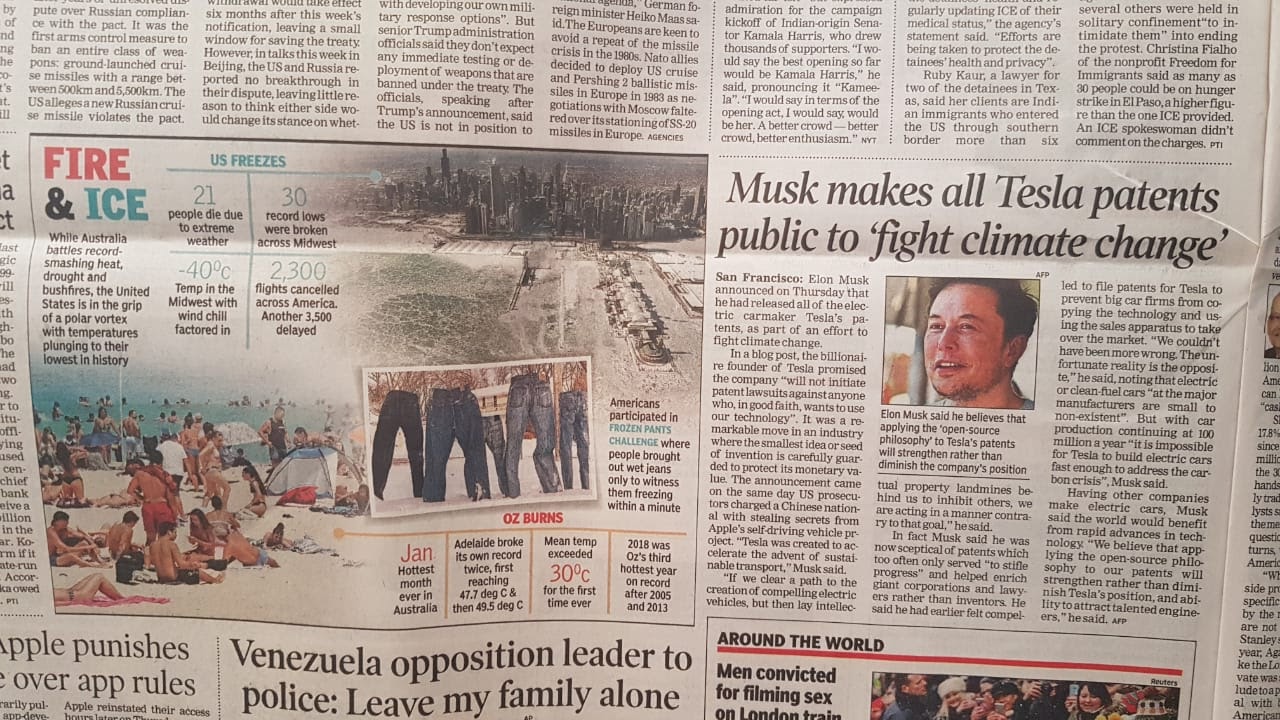
Extreme weather events in two corners of the world- Adelaide Australia roasts at 49.5 degrees Celsius, while Chicago deep-freezes at -25 Degrees.
Look at the article on the left, and on the right. Elon Musk- he may be vain (the marijuana smoking on interview incident, the $420 takeover bid post), but overall, give that man a medal!

At the same time, look at this guy below. If the above is one reaction, the below is the complete extreme.

@RDT: 1) There is Global warming in the other end of the globe, and 2) The cold spell is due to breaking of the Polar vortex above the Arctic, which is, though not conclusively, attributed to warming temperatures above the arctic. Hence, you are wrong.
Apart from bristling in rightful opprobrium, when one does think about it- there is an urgent need to change the term Global Warming, as I had read somewhere recently. Firstly, to dwellers of the Chicagovian winter - be it any winter and not just this extreme one- 'Global warming' seems like a welcome change. The piece I read said that 'warm' has come to mean 'comforting' and 'welcoming', and analogies apart I would imagine it is especially comforting to those braving sub-zero winters in the "Northern" economies, and these Northern economies represent a majority of the world's empowered voting population (EU and US), and a majority of world GDP. The term 'Global warming' would engender citizen-driven change if the center of the world's economically powerful voting population was in the Sahara desert in Africa, but it's not- it's probably in NYC which is freezing right now. Therefore, please call it Climate Change, and not 'Global warming'.
Edit 1: Comment by Adi C with which I wholeheartedly concur: You're right, the term 'Global Warming' might seem a welcome change to areas that are freezing. However, even 'Climate Change' may not sound dangerous enough, and may just indicate a change for the better (cooler summers in Adelaide, warmer winters in Chicago). I think they should come up with a term that is objectively viewed as negative, say 'Climate Deterioration' or something. What say?
Look at the article on the left, and on the right. Elon Musk- he may be vain (the marijuana smoking on interview incident, the $420 takeover bid post), but overall, give that man a medal!
At the same time, look at this guy below. If the above is one reaction, the below is the complete extreme.

(sharing credits: Avtansh, who is experiencing the deep freeze in NJ)
Apart from bristling in rightful opprobrium, when one does think about it- there is an urgent need to change the term Global Warming, as I had read somewhere recently. Firstly, to dwellers of the Chicagovian winter - be it any winter and not just this extreme one- 'Global warming' seems like a welcome change. The piece I read said that 'warm' has come to mean 'comforting' and 'welcoming', and analogies apart I would imagine it is especially comforting to those braving sub-zero winters in the "Northern" economies, and these Northern economies represent a majority of the world's empowered voting population (EU and US), and a majority of world GDP. The term 'Global warming' would engender citizen-driven change if the center of the world's economically powerful voting population was in the Sahara desert in Africa, but it's not- it's probably in NYC which is freezing right now. Therefore, please call it Climate Change, and not 'Global warming'.
Edit 1: Comment by Adi C with which I wholeheartedly concur: You're right, the term 'Global Warming' might seem a welcome change to areas that are freezing. However, even 'Climate Change' may not sound dangerous enough, and may just indicate a change for the better (cooler summers in Adelaide, warmer winters in Chicago). I think they should come up with a term that is objectively viewed as negative, say 'Climate Deterioration' or something. What say?
Labels: Musings
Tuesday, May 01, 2018
Yin Yang pairs I've caught in the wild
Everyone has their
list of yin-yang pairs that appeal to them. Here's mine.
1. Feeling unique vs
feeling as part of the crowd
2. Sitting reading vs. Out drinking OR trekking in nature
Wordsworth:
Books, a dull and
endless strife,
One impulse from a
vernal wood, May teach you more of man,Of moral evil and of good,
Than all the sages can
3. During R&R (rest and relaxation) Stand and stare vs. immerse yourself into some high energy activity
4. The entire business
classic 'Built to Last' is all about Yin Yang which is the secret sauce of the
'built to last' companies. The book implores you to ditch the 'tyranny of OR'
and embrace the 'Genius of AND'. It talks about how companies rigidly preserve
their core yet stimulate progress around it. And a bunch of other such examples
(big hairy audacious goals AND incremental evolutionary progress). The books
goes on to quote Scott Fitzgerald: "The test of a first-rate intelligence
is the ability to hold two opposed ideas in the mind at the same time, and
still retain the ability to function"
5. Wave vs. Particle
On this front, really
like the name of the band - 'Dualist Inquiry', who I'd heard live at Mehboob
Studio with MM, one fine evening in 2010 odd.
Nice number: Qualia . This
is definitely not my favorite genre, but he played well.
This is a running
post. Will keep adding to it as yin yang balls come bouncing at me from the
wild and I catch em, like trapping Pokemon, in my Yin Yang blog post.
Additions:
6. Being a player vs being an observer
7. Being Grateful for what you have, vs being dissatisfied and looking for improvement
8. Listening to others vs ignoring others and doing your thing
9. Enjoying the journey andknowing that it's about the journey not a destination, but setting a destination so that you have a journey to go to, and you don't have nagging existential questions during the journey because you know that the goal, when you get there, is worth the while (added Mar 16)
Labels: Musings
Sunday, April 29, 2018
Good conversation is like a good cricket pitch
Gotto have good pace, bounce and lateral movement.
- Pace: Rapid exchange of information
- Bounce: The other person reacts to your stimuli, and adds his or her own nuggets. Refinement from conversation with RR- the person need not only "add" a nugget- the other person may be an active listener, too. A genuine murmur of understanding may also count as legitimate bounce.
- Lateral Movement: Offbeat inputs and topics should come into the picture instead of the straight and narrow- conversation should not be along "predictable lines". Bold new angles and new perspectives to make the conversation move in interesting directions, such that where you end up is different from the 'line' on which you started.
Labels: Musings
Saturday, April 29, 2017
Vicious AC cycle: 1 cooling to you gives 15 heating to Atmos
These days, you're either subject to the harshness of the (natural) oven or you are under the benevolence of an air conditioner. I played cricket past two Saturdays, and got absolutely taken out. Before I could hit any stroke, the sun hit its stroke and I was down for the count. My friend ST's whatsapp status reads "Invincible summer".
(Distracting pun here; did not want to disturb the flow of the para above: A good sun stroke hits the sweat spot while a good cricket stroke hits the sweet spot)
Firstly, we corporate MBA types have been spoilt by air conditioning. As a kid in Delhi, my "PT" class was the last, and I would run around between 1 and 2 PM with merry abandon. Now look at me!
Secondly, coming to the nub of the matter here. So, it's getting hotter. We use the AC for longer hours. We expel all the heat from the heat exchanger, and make it even further hotter outside. Further, we've anyway generated more than 50% of our electricity from coal, having already added a good amount of CO2 to the atmosphere. What's going to stop this vicious thermodynamic cycle? I'm just saying thermodynamic because I remember all those Pressure and Enthalpy cycles we used to plot during UG days (Thermodynamics 101), and also perhaps to add some gravitas to the writing.
Actually going to the thermodynamic heart of it, the underlying thermodynamic cycles of thermal power generation and the air conditioning are inherently inefficient- can't go to 100 no-sir-no. The efficiency of ACs in India (some kind soul did a survey, link below) is 20%. On top of that, factor in the 30-40% efficiency of coal plants (wikipedia confirming vague memory from "Power Plant Engineering" course; that's around the theoretical maximum of the "Rankine cycle"). And then the 20% transmission losses to get it to you here via power lines. So when NTPC burns coal, only 0.2*0.4*0.8 =6% of that is coming to you. Rest is all heat dissipated into the atmosphere.
One way to think about it: for one cooling unit into your room, you have let out 15 units of heating into the atmosphere. As you put out 15 units, it becomes hotter. And you have to release 2 units of cooling into your room in the next hour. But wait, you've released 30 units now.
Now I'm supposed to give solutions, like a lame, formulaic essay? Ok, so go out in the sun in the mornings, and thus get used to the heat more, and after that maybe you'll need the AC less number of hours. The 175 GW Solar target set by GoI will help. Lastly, watch the lights at home. If not the AC, save in some other form. Oh, and read the biography of Elon Musk, so that you get inspired and purchase a Tesla (whenever feasible) and install solar on your roof. Oh, and you upwardly mobile MBA types- purchase a fuel efficient car, not an SUV.
Link to kind soul's work: http://consumeraffairs.nic.in/consumer/writereaddata/splitac.pdf
(Distracting pun here; did not want to disturb the flow of the para above: A good sun stroke hits the sweat spot while a good cricket stroke hits the sweet spot)
Firstly, we corporate MBA types have been spoilt by air conditioning. As a kid in Delhi, my "PT" class was the last, and I would run around between 1 and 2 PM with merry abandon. Now look at me!
Secondly, coming to the nub of the matter here. So, it's getting hotter. We use the AC for longer hours. We expel all the heat from the heat exchanger, and make it even further hotter outside. Further, we've anyway generated more than 50% of our electricity from coal, having already added a good amount of CO2 to the atmosphere. What's going to stop this vicious thermodynamic cycle? I'm just saying thermodynamic because I remember all those Pressure and Enthalpy cycles we used to plot during UG days (Thermodynamics 101), and also perhaps to add some gravitas to the writing.
Actually going to the thermodynamic heart of it, the underlying thermodynamic cycles of thermal power generation and the air conditioning are inherently inefficient- can't go to 100 no-sir-no. The efficiency of ACs in India (some kind soul did a survey, link below) is 20%. On top of that, factor in the 30-40% efficiency of coal plants (wikipedia confirming vague memory from "Power Plant Engineering" course; that's around the theoretical maximum of the "Rankine cycle"). And then the 20% transmission losses to get it to you here via power lines. So when NTPC burns coal, only 0.2*0.4*0.8 =6% of that is coming to you. Rest is all heat dissipated into the atmosphere.
One way to think about it: for one cooling unit into your room, you have let out 15 units of heating into the atmosphere. As you put out 15 units, it becomes hotter. And you have to release 2 units of cooling into your room in the next hour. But wait, you've released 30 units now.
Now I'm supposed to give solutions, like a lame, formulaic essay? Ok, so go out in the sun in the mornings, and thus get used to the heat more, and after that maybe you'll need the AC less number of hours. The 175 GW Solar target set by GoI will help. Lastly, watch the lights at home. If not the AC, save in some other form. Oh, and read the biography of Elon Musk, so that you get inspired and purchase a Tesla (whenever feasible) and install solar on your roof. Oh, and you upwardly mobile MBA types- purchase a fuel efficient car, not an SUV.
Link to kind soul's work: http://consumeraffairs.nic.in/consumer/writereaddata/splitac.pdf
Labels: Musings
Saturday, June 25, 2016
New religion "Real Gods" complete with puja room, holy books, holidays
How about a new religion, "Real Gods", wherein the gods are the foremost achievers in their respective fields in the recent times? Think back to the classic "puja" shelf at home- for the Hindu ones amongst you the memory should be quite clear- with framed photos of different gods. These photos are to be replaced by framed photos of Mohammad Ali, Steve Jobs, Sachin Tendulkar, Nikolas Tesla, Mahatma Gandhi, Mary Curie, Warren Buffet, Florence Nightingale and the likes. This "puja room" is a critical ingredient of this religion- mandatory in the houses of a believer of "Real Gods". Apart from a place of workship, what are the other key aspects of religion? Holy books. Holy books are the best biographies or autobiographies of such people. And the other key aspect is religious holidays. Holidays in Real Gods are on key days of Gods' lives- for example October 30th is celebrated is a "Aliday" (even sounds like holiday) as the day of the "Rumble in the jungle" bout. Birthdays are not celebrated as anyone can just be born, but what is celebrated is the key days in this persons life related to their godliness, as in the Aliday example.
And all through reading this article, please do remember that I am only half-joking. I really-truly think this religion can make the world a better place. By idolizing the practices of the best of us, we can only get better, as a race.
Real gods are fallible, though, and the god-list keeps getting updated. For example, Lance Armstrong, Tiger Woods, Oscar Pistorious could have been gods but after their indiscretions were exposed, they get removed. Removal is performed by the "Council of Real gods" - an elected body. And Gods don't get removed for just resorting to Machiavellian tricks like the whole Winklevoss episode surrounding Zuckerberg (this is purely for argument' sake coz I don't think Zuck would anyway be a cinch for a God) - because remember Krishna? He was quite the Machiavellian. It's only downright violations like those of Armstrong, Woods, Pistorious that lead to removal from the Pantheon. It's a grey area, of course, but that's why the qualified Council is there. The god-list would also be refreshed to ensure that the current god-list stays relevant to the current times. Once a god, always a god, of course, but official celebrations (holidays, mainly) would cease once the god is removed from the official list from the Council.
This is inline with standard Hindu pantheon philosophy, btw, of multiple gods for different vocations. Such as Goddess Saraswati for education and Goddess Lakshmi for wealth. There could be a Steve Jobs - God of creativity in business, Tendulkar - god of performance despite humongous expectations, Tesla - god of invention (300 patents!), and so on. I like the concept of many gods of Hinduism, and that is replicated in Real Gods. For example, there is a God of Coaching, say Brian Clough (whose coaching achievements are gloriously depicted in the movie "Damned United"). These facets of godliness get highlighted, for gods, and other routine life details may be left out. For example, we really don't know about other about the wealth of Goddess Saraswathi or the literary pursuits of Goddess Lakshmi. Since its a pantheon, everyone can has their favorite gods, of course. to whom one can choose to be most devout towards.
What happens on religious holidays? Full multimedia experience to ensure you understand and imbibe some of the godliness that made this person a god. You read extracts from the biographies that morning, and indulge in an activity relevant to that god. For example, on "Jobs days", (Jan- 9, 2007, the day when the iPhone was launched) you read extracts such as the below:
"Creativity is just connecting things. When you ask creative people how they did something, they feel a little guilty because they didn't really do it, they just saw something. It seemed obvious to them after a while. That's because they were able to connect experiences they've had and synthesize new things. And they reason they were able to do that was that they've had more experiences or they have thought more abut their experiences than other people. "
Reading all this will give you a true sense of the godliness of this person (Jobs being Creativity in business). It would be a multimedia and interactive puja. You would listen to Jobs' Stanford commencement speech, watch the best of Jobs' speeches. You would go buy, and wear, the famous black Turtleneck sweatshirts. And you would do an activity, such as design your own new technology product, which would be submitted to the Council a week before. The winner would be announced on Jobs' day.
So what say, are you sold? Accepting donations starting today.
Note: It so happens that this also resonates with standard IIT-B lingo. Whenever someone does something truly spectacular, then they are venerated with the term "Tu god hain".
And all through reading this article, please do remember that I am only half-joking. I really-truly think this religion can make the world a better place. By idolizing the practices of the best of us, we can only get better, as a race.
Real gods are fallible, though, and the god-list keeps getting updated. For example, Lance Armstrong, Tiger Woods, Oscar Pistorious could have been gods but after their indiscretions were exposed, they get removed. Removal is performed by the "Council of Real gods" - an elected body. And Gods don't get removed for just resorting to Machiavellian tricks like the whole Winklevoss episode surrounding Zuckerberg (this is purely for argument' sake coz I don't think Zuck would anyway be a cinch for a God) - because remember Krishna? He was quite the Machiavellian. It's only downright violations like those of Armstrong, Woods, Pistorious that lead to removal from the Pantheon. It's a grey area, of course, but that's why the qualified Council is there. The god-list would also be refreshed to ensure that the current god-list stays relevant to the current times. Once a god, always a god, of course, but official celebrations (holidays, mainly) would cease once the god is removed from the official list from the Council.
This is inline with standard Hindu pantheon philosophy, btw, of multiple gods for different vocations. Such as Goddess Saraswati for education and Goddess Lakshmi for wealth. There could be a Steve Jobs - God of creativity in business, Tendulkar - god of performance despite humongous expectations, Tesla - god of invention (300 patents!), and so on. I like the concept of many gods of Hinduism, and that is replicated in Real Gods. For example, there is a God of Coaching, say Brian Clough (whose coaching achievements are gloriously depicted in the movie "Damned United"). These facets of godliness get highlighted, for gods, and other routine life details may be left out. For example, we really don't know about other about the wealth of Goddess Saraswathi or the literary pursuits of Goddess Lakshmi. Since its a pantheon, everyone can has their favorite gods, of course. to whom one can choose to be most devout towards.
What happens on religious holidays? Full multimedia experience to ensure you understand and imbibe some of the godliness that made this person a god. You read extracts from the biographies that morning, and indulge in an activity relevant to that god. For example, on "Jobs days", (Jan- 9, 2007, the day when the iPhone was launched) you read extracts such as the below:
"Creativity is just connecting things. When you ask creative people how they did something, they feel a little guilty because they didn't really do it, they just saw something. It seemed obvious to them after a while. That's because they were able to connect experiences they've had and synthesize new things. And they reason they were able to do that was that they've had more experiences or they have thought more abut their experiences than other people. "
Reading all this will give you a true sense of the godliness of this person (Jobs being Creativity in business). It would be a multimedia and interactive puja. You would listen to Jobs' Stanford commencement speech, watch the best of Jobs' speeches. You would go buy, and wear, the famous black Turtleneck sweatshirts. And you would do an activity, such as design your own new technology product, which would be submitted to the Council a week before. The winner would be announced on Jobs' day.
So what say, are you sold? Accepting donations starting today.
Note: It so happens that this also resonates with standard IIT-B lingo. Whenever someone does something truly spectacular, then they are venerated with the term "Tu god hain".
Labels: Musings
Friday, April 03, 2015
IIMB Convocation: D. Shetty straight from the heart, other highlights and sentimental musings
Dr. Devi Shetty, heart surgeon and founder of Narayana Hrudayalaya, was the Chief Guest at the 40th Convocation of IIMB, in which yours truly was also conferred a degree. Narayana Hriduyalaya is across 17 cities and 27 hospitals. B School connect- a) Aravind Eye and Narayana are poster boys of India's affordable health care, and both are subjects of HBS cases, b) Narayana also used to recruit at IIMB.
So, convocation and all - much pressure on the speaker. But Mr Shetty rose to the occasion to deliver a touching speech. He's used to it- he touches the heart all the time. Here are some highlights from his thought-provoking address:
-A business model meant for the poorest man in the country (insert Gandhi quote: is your step going to be of use to the poorest and weakest man) is a great model. The rich just follow the poor. Argument bolstered by the success of the Yeshaswini micro insurance plan, under which Devi Shetty drove the Karnataka govt. to provide micro insurance to the poor. For a monthly payment of Rs 5 per person, with the government contributing Rs 2.5, "the scheme offers free consultation, diagnostics at discounted rates and all kinds of operations". Apparently the world's cheapest such insurance scheme. I suppose India is the best place to run such "economies of scale" models, and Mr. Shetty is a champ - Yashaswini and the entire low-cost Hriduyalaya model. He also later talks about how "Charity is not scalable"
-"Never doubt that a small group of thoughtful, committed citizens can change the world; indeed, it's the only thing which has" - Margaret Mead. Also added, "If you want to walk fast walk alone. If you want to walk far, walk together"
-"God has something better for you". Kiran Mazumdar Shaw (KMS hereon) is apparently a buddy of Mr. Shetty - she donated 30 Cr for his Cancer hospital in Bangalore which is even named after her (for KMS' husband was once a Cancer patient. She's doing a Glenn McGrath here). So, KMS wanted to become a doctor, and she did not clear the entrance exam, and therefore moved on to Biotech et al, and look what has resulted a $1.5 Bn mkt cap, poster boy of Indian biotech. My thought is that when confronted by big decisions, or forks, it helps to take a chill pill by keeping in mind- You will do well either way! Like KMS did.
-"Behave like a thief". Time for audience CP- what does the thief do when he enters first? (No one got it- the degree is here anyway, so who cares about CP marks). He keeps the back door open. So, keep the exit options open, he says. This led to a trail of thief jokes later in the day - "You are supposed to return the gown! Oh, you are keeping it? Ah, think like a thief eh?"
-Couple of nice lessons drawn from his time at the surgery table. I think, for an expert in a field, one can extract such good ideas from their area of expertise/work - "The safest surgeon is one who doesn't operate", and "money is like oxygen. It is not the purpose of life, but you can't live 3 minutes without it"
-"World is not ruined by the activity of bad people, but by the inactivity of good people". My thoughts- think World War II, and Appeasement by Britain and UK. Mr Shetty gives an example of how the Karnataka government imposed a service tax which would have hurt the poor's ability to pay for medical expenses. Mr Shetty and "A few good men" rallied forces and went on street marches, and got the state tax rescinded. While pinch of salt is advised because there may have been Narayana Hriduyalaya bottomline impact driving Mr Shetty's action, the point is well taken.
-Has had some good help from the Indian business ecosystem. I mentioned above KMS' 30 Cr donation. He also mentioned how L&T built for him a super-specialty hospital for $6 Mn instead of the industry standard $20 Mn, and in 6 months instead of the regular 3 years. A doff of the hat to IIMA there - Mr AM Naik, Chairman of L&T, has just awarded degrees at IIM A - he's the KMS equivalent for IIM A.
-Taking notes, or planning to take notes, forces you to listen.
Some good life lessons in here, and I plan to read some of the above and imbibe.
Ceremony light (and tight) moments
- Present in absentia. Madhuvanthi was declared to be receiving her degree "in absentia", but then she showed up uninvited on the stage, creating immense confusion among the august gathering of the IIM B Executive board on stage. KMS, who handed out the degrees, was the most perplexed.
- Handle-barred. Yours truly's mustachio'd pic, which appeared in the rehearsal and caused a bit of an uproar, was removed, thanks to the well-meaning intervention of Prof Pranav Garg (who was quite the Master of Ceremonies for the convo). In place of the macho Harley rider appeared this lame MBA nerd, to the vocal disappointment of the PGP audience. However, the mustachio'd pic still remains on the Alumni card.
- Pro-nuance-ing names. The new PGP chair started off her evening well with a good speech- while everyone else was heaping praises on the Graduates, she turned the tables on them and said the focus should be on the parents, who have done as much, if not more, for their wards to earn the right to sit. Rightly so. However, her day went downhill after that, because she was entrusted with the no-doubt onerous task of reading out 398 names, and she blew it. She did not exhibit any trace of pro-nuance-ation, as she split some common Indian names into English words while reading out. Think Ash + Win for Ashwin - she did this for some names. Her discomfort soared with complex South Indian names
- Light and tight. The graduation hat was very tight and the flourescent lights were blazing, and caused a bit of a headache.
The graduates. My weird expression because i'm really stretching my hand to get the selfie. It hurts.

Sentimental musings
I was among the last 10% of the batch to leave. And it was sad to say one goodbye after another. What is striking is that today, the stone-walls, the room, the people, the Park and Eat food, everything means home; but just a day later- you sleep and wake up- and you have to erase that part of your life and all the above stop meaning "home". I can remember Harsh, the car-driving Bangalorean, packing up with bags and baggage just the day after convocation despite having all the flexibility, because the emptying out of G-Top was understandably too much to handle. What is usually the best thing about campus - you walking around and bumping into random batchmates and striking up a conversation - at NC, at ABP, in the corridors, turned very sour because each of these conversations turned into a farewell.
Among the last 2(3) of 7 to leave G-Mid. We're sad to.

Ramblings: The best Chief Guest speech ever - Gussie presents the prizes by PG Wodehouse, In Absentia is a great Porcupine Tree album.
Labels: Musings
Tuesday, April 01, 2014
NLS Debate; Laser Guided Precision vs. Carpet Bombing Hailstorm
Contents
In what is a first for this blog, a post has a Contents section- because this one's on the longer side. In fact, it is probably a record breaker on this blog in terms of length, and by writing that it's a record breaker, and thus prolonging this sentence, I have probably ensured it's a record breaker- talk about self fulfilling prophecies, eh?
1. Resounding Resurrection
2. Parliamentary debating; and the battles we fought
3. Our evolution as a war machine, and the three branches of the Military
4. Learnings, and how to win (NO RAMBLE SECTION)
5. Much-abused phrases, and lingo
Resounding Resurrection
If an operative joins an illegal
organization, say Mr. Ibrahim's D Company, at entry level and rises up
to the top, can the journey be described as - "From NoVice to Vice
Captain?"
With that signature splash of dirt, I re-enter the blog bog.
So, speaking of novices, three
novices in the dark art of Parliamentary Debating trooped off to National
Law School, setting off from IIM-B - extreme BLR south- towards NLS - extreme BLR West- tracing a course North by Northwest (I gotto watch the movie).
Parliamentary debating; and the battles we fought
While I've done
parliamentary debates in undergrad, that was very different from the rulebook
here. All "Parliamentary" at UG meant was that the topics would be wide, such as "Good fences make good neighbors", which could be
interpreted as anything under the sun by the proposition, and the opposition has to gamely fight. The proposition could
interpret the above as "India should always maintain strong military presence
along the LOC" (which is like saying "Good De-fences make good
neighbors", hohoho) or could declare "University campuses should have strict entry restrictions at its gate for the good of all society".
However, here, the thrust of the Parliamentary nature is not the topic- it's the format. Proposition has three speakers designated PM, Deputy PM and Whip
(Frank Underwood!), while Opposition has Leader of Opposition, Dep. LO
and Whip. So 3 speeches per team, 7 minutes per speech, and 30 minutes of prep time. Further, you are allowed to choose from 3 topics in each round, and the topic is arrived at based on mutual agreement. Here's the list of topics we locked horns on, on each occasion with a different university:
1. "For contesting in college elections, candidates should satisfy a minimum academic threshold" Our position: Opposition. Verdict: Win. Score: 1-0.
2.
"College placements should have a one person-one job policy" Our Position: Government. Verdict. Loss. Score: 1-1. Now this topic falls squarely in our backyard because this is precisely what we were
subjected to just a couple months back, and after all it's the apex of first
year MBA activity. However, very shamefully, we lost.
3. "In post conflict nations, the resulting first democracy need not separate the arms of the state" Our Position: Opposition. Verdict: Loss. Score: 1-2. Arms of the state of course refers to Legislature, Judiciary and Executive. The debate centered around how separation is required (us) for long term good (institution building, how early errors can be horribly harmful) vs how separation would cause needless delays in providing for the immediate needs of the torn society.
4. "For violation of copyright of works of art or literature, the "Pastiche" defence should be acceptable in the courts of law" Our position: Opposition. Verdict: Win. Score: 2-2. An example of pastiche is the TV series Sherlock, which is a pastiche of the original Holmes. The "pastiche" is supposed to celebrate the original work, and should not slander. In Sherlock, of course, there is no reason for a defence, because the copyright for Holmes has elapsed. We were arguing against the validity of a "pastiche" defence- how it amounts to stealing.
5. "Interventions in areas outside a state's effective control but within its political territory are justified" . Our position: Opposition. Verdict: Win. Score: 3-2. The motion implies Pakistan's intervention in Kashmir, or NATO's intervention in Libya, are justified. After the win here, we were in with a chance of "breaking" if we won the last two, and on the back of two successive wins, the team mood was sprightly.
6. "Governments should fix an upper limit on the extent to which foreign countries can acquire their national debt". Our position: Government. Verdict: Loss. Score: 3-3. We fought valiantly, but the lawyers from NLUD brought us down. Our hopes of "breaking" were punctured.
6. "Governments should fix an upper limit on the extent to which foreign countries can acquire their national debt". Our position: Government. Verdict: Loss. Score: 3-3. We fought valiantly, but the lawyers from NLUD brought us down. Our hopes of "breaking" were punctured.
7. Long topic, the gist of which is: "The immigrant should return home to the developing country", or as we read it, "Dr Mohan Bhargava should come back to Swades". Our position: Government. Verdict: Unknown.
Laser Guided Precision vs. Carpet Bombing Hailstorm - Speed Reading aka Spreading.
3 of our 7 opponents were law schools, and when we went to war with them, there was a clear difference in the art of war. While we B-schoolers, trained in the art of MECE, shot carefully aimed laser guided missiles, each a 20-kiloton monster, into enemy territory, our opponents let loose a hailstorm of low yield missiles. Throughout, it was a battle between the two strategies, and in the first two debates, carpet bombing prevailed. Our air defence systems were built to intercept a few, big missiles, and were overrun by the hailstorm of small weaponry. And I tell you- I am NOT stretching the analogy- these lawyers, they talk so bloody fast! However, there is a limit to what they do, which we saw in the last debate- when we ourselves had evolved and ended up stretching to weakness our opponent's strategy. At the end of this last debate, one of the adjudicators called our opponents' bluff and actually pointed out that the word speed was so high that the speaker had become unintelligible, and and many of the points made were just the very same thing in different words. We felt vindicated and gratitude swelled in our hearts for this wise judge.
However, what I described was just a milder form of "Spreading", a common practice in Debates in the US. Spreading is short for Speed Reading, and seems utterly ridiculous to me. Just watch for 10 seconds the speaker from Harvard spread it:
Our evolution as a war machine, and the three branches of the Military

As I said, we evolved our attack and defence strategies- Our attack consisted of many more salvos, even while compromising a bit on the power of each shot fired, while our air defence systems developed a higher sensitivity so as to seek and destroy fast enemy fire. Ad nauseam analogies apart, we understood the roles of the three speakers better, and our rebuttals were much more refined- we ensured we picked up every point which the opponent made, and tore into them. And now coming back to Ad Nauseaum analogies to demonstrate how we understood the the roles of the three speakers: the First Speaker was the Air Force, who did a reconnaissance in terms of contextualizing the topic and carrying out surgical first strikes in the enemy territory- Shock and Awe, baby! The Second Speaker was the Navy, armed with with aircraft carriers, which surrounded the enemy and sent sortie upon sortie of fighter aircraft and missiles, while simultaneously intercepting and destroying enemy sorties and missiles using anti aircraft guns and missile defense systems. The Whip was the Army, who did the final job after the Air Force and Navy had completely handicapped the enemy- the ground troops stormed in, wiped out any remnants of resistance, established our rule on the ground, and finished off the war.
Learnings, and how to win (NO RAMBLE SECTION)
1. Complete an argument to the fullest extent. Ok, your partner raised a point during prep time, even if it makes some sense, question. Two questions are important, "Why" and "So what". Always drill down to the ultimate elemental level- Why to check relevance, and So What to check import. That's during prep time, and when speaking, too, connect all the dots. Dots connected by the judge do not count in your favor.
2. To repeat- seek and destroy. Isolate every argument in the opponent's speech, and be sure to knock 'em down. Ensure you "engage" with the opponent, build "clashes" and towards the end- the Whip's speech- show to the judge how you won the clashes. The whip is a "biased adjudicator".
3. Secret to surefire Opposition win- Show how the govt's proposal is WORSE than the status quo, and put forth an alternate solution that is BETTER than the govt's solution.
Learnings, and how to win (NO RAMBLE SECTION)
1. Complete an argument to the fullest extent. Ok, your partner raised a point during prep time, even if it makes some sense, question. Two questions are important, "Why" and "So what". Always drill down to the ultimate elemental level- Why to check relevance, and So What to check import. That's during prep time, and when speaking, too, connect all the dots. Dots connected by the judge do not count in your favor.
2. To repeat- seek and destroy. Isolate every argument in the opponent's speech, and be sure to knock 'em down. Ensure you "engage" with the opponent, build "clashes" and towards the end- the Whip's speech- show to the judge how you won the clashes. The whip is a "biased adjudicator".
3. Secret to surefire Opposition win- Show how the govt's proposal is WORSE than the status quo, and put forth an alternate solution that is BETTER than the govt's solution.
Much abused phrases (1,2), and lingo (3,4)
1. Checks and Balances - Debate 3 and Debate 6 , about Arms of the State and about Debt Limits- you can easily see why this phrase could easily end up being used 50 times in each debate.
2. Selling your soul - Debate 6, about how foreign debt might mean Selling Your Soul.
3. Constructives, Substantives - One and the same- new points, as against rebuttals.
4. Proud to Propose/Oppose - Many a speech end with this proclamation.
5. Clashes, and Engagement- Clash- when there's a clear issue on which both teams have locked horns with vigour, and engagement is the process by which you create a clash.
5. Clashes, and Engagement- Clash- when there's a clear issue on which both teams have locked horns with vigour, and engagement is the process by which you create a clash.
Labels: Musings
Tuesday, January 08, 2013
2012, 2015, 2018- "Apocalypse ..3 Years Hence"
So now that 2012 went by with a whimper, without the slightest trace of apocalypse (the closest we got was peering down the edge of the "fiscal cliff", and on the Apocalypse scale, a fiscal cliff is just pathetic) I think it's time for the next movie: 2015. I know, I know we had the authority of the Mayans behind 2012, but so what. It could have been an error, an oversight by the Mayan calendar-maker.
In fact, every movie in the "Apocalypse
So anyhow, it is established that the correct apocalypse date is actually 2015 (or 2018, 2021 and so on..) and then the writer/director proceeds to weave a different disaster tale on every occasion. Sun spots, alien attack, flu contagion, so on.
There can be a huge societal benefit from making and consuming the "Apocalypse
Sorry, I got distracted, what I meant to say is, regular consumption of "Apocalypse
Labels: Musings
Sunday, January 22, 2012
People in books never read books
You pick the characters, you pick the book. The witty, the wise, the charming, the scheming; nobody reads.
I am reading "The Big Sleep" starring noir detective hero Philip Marlowe. And this is not much of a spoiler- Philip Marlowe does not read anything. There is no mention of him having read anything. He could have picked up an Arthur Conan Doyle maybe to sharpen his skills, or he could have done so on a dull day to inspire himself to reach for the professional heights which Mr. Sherlock Holmes reached in his day.
Tinker Tailor Soldier Spy. George Smiley. Consummate professional. Master spy. Possessor of abundant wisdom. And nowhere, despite much of the book being a soliloquy, is he reading. There's a small part in the beginning where he is carrying a book by a German author (Grimmelshausen, I just opened up the TTSS), but that's for his wife Ann.
Harry Potter, say. In all their years we watched them so closely, I don't remember our chaps doing any extra curricular reading apart from an illustrated book on magical creatures and another illustrated book on Quidditch. Lord of the Rings. Living on the edge as they do, where do our gallant heroes have the time for reading?
Saleem Sinai, in Midnight's Children. Col. Mike Martin, in Fist of God, Ikon and the Afghan. The sisters in Atonement, and the Captain. Nobody. A welcome change is "Kalle" Blomkvist in the Millennium series. He reads quite a bit of Swedish detective fiction.
In the fantasy genre, what fantasy would those guys be reading? The Lannisters and the Starks, of Song of Ice and Fire fame, they have seen people coming back from the dead, fire breathing dragons, massive wolves, and all kinds of miracles. So, what fantasy would they themselves read? That's a good angle to explore. Bran Stark, when he is sitting injured in bed (that happens very early, not much of a spoiler), is reading the bestselling fantasy book of his time. And, the story unfolds..the recursion would call for some imagination, and could make for a good tale.
Given that we want to get under the skin of the character and relate to him or her, the character should appreciate our efforts to get to know him, and he/she can do that by indulging in a bit of the same. I have spend a considerable portion of my wakeful hours reading, and I want some of these people to do that too.
And I would finish with one of the few tracts of poetry which I can quote, one of my grandpop's favorites:
Books, a dull and endless strife..
..
One impulse from a vernal wood,
May teach you more of man,
Of moral evil and good,
Than all the sages can.
-William Wordsworth
I am reading "The Big Sleep" starring noir detective hero Philip Marlowe. And this is not much of a spoiler- Philip Marlowe does not read anything. There is no mention of him having read anything. He could have picked up an Arthur Conan Doyle maybe to sharpen his skills, or he could have done so on a dull day to inspire himself to reach for the professional heights which Mr. Sherlock Holmes reached in his day.
Tinker Tailor Soldier Spy. George Smiley. Consummate professional. Master spy. Possessor of abundant wisdom. And nowhere, despite much of the book being a soliloquy, is he reading. There's a small part in the beginning where he is carrying a book by a German author (Grimmelshausen, I just opened up the TTSS), but that's for his wife Ann.
Harry Potter, say. In all their years we watched them so closely, I don't remember our chaps doing any extra curricular reading apart from an illustrated book on magical creatures and another illustrated book on Quidditch. Lord of the Rings. Living on the edge as they do, where do our gallant heroes have the time for reading?
Saleem Sinai, in Midnight's Children. Col. Mike Martin, in Fist of God, Ikon and the Afghan. The sisters in Atonement, and the Captain. Nobody. A welcome change is "Kalle" Blomkvist in the Millennium series. He reads quite a bit of Swedish detective fiction.
In the fantasy genre, what fantasy would those guys be reading? The Lannisters and the Starks, of Song of Ice and Fire fame, they have seen people coming back from the dead, fire breathing dragons, massive wolves, and all kinds of miracles. So, what fantasy would they themselves read? That's a good angle to explore. Bran Stark, when he is sitting injured in bed (that happens very early, not much of a spoiler), is reading the bestselling fantasy book of his time. And, the story unfolds..the recursion would call for some imagination, and could make for a good tale.
Given that we want to get under the skin of the character and relate to him or her, the character should appreciate our efforts to get to know him, and he/she can do that by indulging in a bit of the same. I have spend a considerable portion of my wakeful hours reading, and I want some of these people to do that too.
And I would finish with one of the few tracts of poetry which I can quote, one of my grandpop's favorites:
Books, a dull and endless strife..
..
One impulse from a vernal wood,
May teach you more of man,
Of moral evil and good,
Than all the sages can.
-William Wordsworth
Saturday, August 13, 2011
Indian Democracy Epic Fail
One Typo, One Mix up and One Missing. Shoddy is a euphemism here.
Today, I had my first real brush with the Indian democracy as an adult citizen. And it left me absolutely disgusted. It's a shame that the "first real brush"comes a few days after my 25th, some seven years after it ideally should have, but the events I describe below completely justify my total apathy in this regard.
After three or four failed attempts to get themselves a voter id card, it seems my parents had finally succeeded- and I was to get my first voter card too. All we had to do was brave the afternoon heat on a ~500m walk to the "Government Urdu School" nearby and collect it from Mrs. Saroja.
On reaching this Government Urdu School, we learn that there exists no such Mrs. Saroja, and they do not have any inventory of voter id cards, of all things. (Roll of eyes by some teacher there) Maybe we could try at Anganwadi (a nearby govt. school). Wonderful, we troop towards Anganwadi, which is in some god forsaken hard to find nook.Mrs. Saroja pulls out a bunch of 100 cards from a dusty old plastic cover, and we make our way through the pack.
First Hit: Dad's card. Typo in the name. Forgivable, you think? I don't think so. Whoever typed that in on a computer is being paid for doing the job. For heaven's sake, do a good job.
Second Hit: Mom's card: Photo matches, but she has been turned into a Mrs. Prabhavati Shetty. Wrong name, wrong address, wrong husband.
No third hit. My card is not there.
By this point, I am absolutely furious. I just walk out of the building into the narrow alley outside. And the father, the Guv'nor, the old man, is patiently talking to our lady. I amble back in after a while. She has pulled out a long notebook which is full of doodles (I remember a particularly ugly swan) and is diffidently lifting a pen as though readying to write down a complaint of sorts. And then, the modus operandi in such cases (doubtless numerous), flashes before her eyes. Form 8. Yes. We need to fill out Form 8. Where would we get Form 8? Ah, we go back to her on Tuesday. Thank you ma'm. Oh wait, where are you going already? 50 Rupees please!
And the father paid up, and joined me outside, shaking his head his exasperation. And I am absolutely..flabbergasted. 50 Rupees!!? And why do I pay my taxes? The parents had already coughed up more than 100 Rupees for the application forms, and now this.
Scam Counter
This was a thought which occurred to me some time back, and now that I have built up a solid head of steam, here;
Scam-Loss to Exchequer-People involved-More Details
1. CWG- INR 220 crore, ($50 MM), Chief Minister of Delhi, CWG Organizing Committe.
And this is just the contract for the Games Village- tip of the iceberg. CWG initial cost estimate in 2003 was $0.3 Billion. Final cost- $13.3 Billion. And Kalmadi now has AMNESIA!? Absolutely insane.
2. 2G-$29.3 Billion - Telecom Minister.
3. Illegal Mining- INR 16,085 cr ($4 Billion) - Chief Minister of Karnataka
4. Adarsh Building- NA- Chief Minister of Maharashtra
5. Mining and Money Laundering- INR 4000 cr ($800 Million) - Chief Minister of Jharkand
Total= $46 Bn. 5% of GDP.
(Assuming CWG $0.3 Bn can go up maximum to $1.3 Bn, quite an allowance in itself)
I am going to keep adding to this list as I recall more. Anyhow, in the last couple of years three chief ministers from some of the biggest states of the country in terms of area, population and economy (Karnataka, Maharashtra, Jharkand) are indicted, and the Delhi CM seems imperiled.
Vigilante, not Gandhians. Or a Tahrir Square of our own.
Neeraj Monga, analyst with Veritas, who recently shot into the limelight with his report charging the Ambanis of fraud, said something in an interview which quite disturbed me. I have no idea about that report of his, so absolutely no endorsement of anything he said there. Anyhow, when asked why he works in Canada and not in the shining India, he said "You have to be devious to succeed in India. I am not." Something to thing about.
Really, looking at all this, one feels at times that the way to take it on is not through Octagenarian Gandhians but youthful vigilante. Or maybe time for a Tahrir Square of our own.
Ending on a lighter note
S and I were talking, about how there should be analysts sitting and tracking scams, too. Tracking and compiling latest data on excel files. With detailed analytical reports and forecasting. And there should be some sort of a composite scam index, weighted over industrial sectors and regions in the country. Reports could be something like , "2Q11 Scams In line with Consensus Estimate; Bullish on Retail Sector given 100% FDI Move""
Credits: S is Shailendra. Sources: Business Today and Wiki for CWG numbers, CAG for 2G, Lokayukta for illegal mining numbers .
Labels: Musings
Saturday, July 02, 2011
Google+ : +1

Circles are beautifully done, so my sister sits in my "family" circle and not on my "wild booze nights" circle. I know for a fact that she is not happy about this: she liked to play "spy kids". Also, the family was getting ignored in these days of social networking, at least in my case. I mean, I couldn't have written "Enjoyed delicious sambar sadam and avial at Mani's restaurant in Matunga" on my FB status without inviting a good number of sniggers and massive public backlash.
Hangout is pretty nice, people at skype must've had a heart attack. Apparently Mr. Zuckerberg has some "exciting changes" lined up, and I guess one of which will most certainly be group chatting. Does not make things any better for the Skype folks. However, there are so few people on google + right now (someone's post called it a "ghost-town") that it's difficult to get a "hangout" running. V and me tried, this morning, and we could not find anyone around.
Huddle is pretty cool, too. Not super innovation, or anything, but it was high time a common chat application like google had the group chat facility.
It's fast changing: although I installed + on my phone three days ago, my Android market is synced to "ashwin.rk@gmail.com" and not "ashwinwins@gmail.com". So I was cursing google for not enabling the Google + App to sync based on other gmail accounts. But I downloaded today's update, hoping wishing praying as the download status bar filled up, and voila! They've done it, the engineers at google. Salut!
Couple of suggestions I had, which I shot off to google in the "feedback" menu from my phone, hope they acknowledge with immense gratitude.
1. Enable different statusses for different circles. When at work, I might want to be "Available" to my work circle, "Busy" to my family circle, and "Invisible" to the ol' wild booze nights circle.
2. Decrease the likelihood of putting posts on the wrong circle. This happened to me yesterday on my mobile, when I put a post meant for "wing" on "friends". Thaknfully, no damage done. There should be an option to enable additional checks on posts to certain circles, such as family. Say a confirmation pop up.
Ideas for you: You can make your gmail user interface look very much like the Google + UI. Under Settings/Themes, choose the theme "Preview Dense". It's a much cleaner UI, and I have switched to it.
So a whole saturday I have pretty much not stirred out (Don't diss, I have plans for tomorrow), and I have logged in to facebook, not even once. I feel like logging in now, as I say this, put will do so only after midnight. I am pretty sure there is a discernible dip in traffic for Facebook last three days. After the smooth sailing so far, here's some testing times for Zuck and co.
However, given the all encompassing platform google has: maps, blog, youtube, gmail, mobile os, search, reader....the possibilites are really immense. I would think in less than a week since inception, FB must see a clear and present danger. Just for the record, I plump for plus.
Credits: The sister. Vivek Srivats for hanging out with me. Shailendra Jain for making me realize that I hadn't logged in to FB the whole day.
Sunday, June 19, 2011
First Mover Disadvantage
(Note: I wrote this in Jan, much of it except for some minor tweaks is from back then: might explain some discrepancies you may come across)
I've heard the phrase "first mover advantage" time and again. Like most phrases/idioms, looking at the exact opposite also makes sense many-a-time. Maybe even more than the original one. Anyhow, these contrary phrases sure are sensational in nature. Case-in-point:"Count your chicken before they hatch". (Or the title which contributed in a way to getting you this far into this mire. Yeah, when it comes to luring people to my blog, I am nothing but just another Arindham Chaudhari and the blog is not different from those full page IIPM ads. I wear black colored thick-rimmed glasses, too. Ponytail is work in progress. Will add a picture of me sporting a wide grin to my blog when the pony is ready to go. To cantor, gallop. Won't be long, hold your horses.) I am sure there must be many, many more management books piggybacking on this theme (can you?). These idioms and phrases, they have the tendency to generalise, due to which it is so very easy to pick holes in the argument they are putting forth. For example, I once came across this: If actions speak louder than words, then why is the pen mightier than the sword. Then, an idle mind is a devil's workshop. Well, the best breeding ground for an outrageously creative idea may be an idle mind. Not a mind that is highly preoccupied by, say, business development presentations. Or client meetings. I am sure you can think up a couple yourself, and then please yourself by creating an argument for the counter. To warm-up, let me throw one at you: "If it ain't broke, don't fix it". Scroll down for the correct answer. If you have other phrase-contrary phrase pairs, please get back to us, and we have attractive prizes lined up for you. Or maybe not, for after all, "The reward of a thing well done is to have done it".
I've heard the phrase "first mover advantage" time and again. Like most phrases/idioms, looking at the exact opposite also makes sense many-a-time. Maybe even more than the original one. Anyhow, these contrary phrases sure are sensational in nature. Case-in-point:"Count your chicken before they hatch". (Or the title which contributed in a way to getting you this far into this mire. Yeah, when it comes to luring people to my blog, I am nothing but just another Arindham Chaudhari and the blog is not different from those full page IIPM ads. I wear black colored thick-rimmed glasses, too. Ponytail is work in progress. Will add a picture of me sporting a wide grin to my blog when the pony is ready to go. To cantor, gallop. Won't be long, hold your horses.) I am sure there must be many, many more management books piggybacking on this theme (can you?). These idioms and phrases, they have the tendency to generalise, due to which it is so very easy to pick holes in the argument they are putting forth. For example, I once came across this: If actions speak louder than words, then why is the pen mightier than the sword. Then, an idle mind is a devil's workshop. Well, the best breeding ground for an outrageously creative idea may be an idle mind. Not a mind that is highly preoccupied by, say, business development presentations. Or client meetings. I am sure you can think up a couple yourself, and then please yourself by creating an argument for the counter. To warm-up, let me throw one at you: "If it ain't broke, don't fix it". Scroll down for the correct answer. If you have other phrase-contrary phrase pairs, please get back to us, and we have attractive prizes lined up for you. Or maybe not, for after all, "The reward of a thing well done is to have done it".
So coming to first-mover-advantage, yeah, you know where I am going. There is always going to be a huge first-mover-disadvantage before ever getting to the point when you start realizing the first-mover-advantage. In the long run the first-mover-advantage may play out, but in the short term one has to acknowledge the first-mover-disadvantage too, and give it some standing in the highly competitive and dynamic world of corporate jargon. After all, nothing is easier than Copy-pasting, that's what the second-mover can do. On that line, even more attractive is the third-mover advantage. That's a series of management books which could be penned by somebody, let's say Mr. Arindham Chaudari as he is already pottering about in this post. First Mover Disadvantage. Sequel: Second mover Advantage. Then, Third Mover Advantage. Ad infinitum/nauseam.
After all the beating around the bush, let me come to the point: how I have seen the first mover disadvantage play out in my life.
1. Couple of years back I bought my Nokia N95 for a bomb, and contributing to the hefty price tag was the HSDPA (3.5G) capability: my research told me the 3G launch was imminent. There was a cheaper SonyEricsson UTMS (3G) option available but then the HSDPA tilted the scales in N95's favor (despite the wad of notes on the pan containing the SE). Of course, there were so many more cheaper phones, which those not keyed in to FMA were happy with. Two years hence, where is 3G in Mumbai? Not yet around! (This reminds me of an article I read in Hindu about whether we are missing the technology bus in India in a big way: 3G was launched in Japan 10 years ago.) So, among all phone-buyers at that time, I wanted to be the first to move into 3.5G phone ownership so I could reap the benefits of FMA by browsing away to glory while others less aware peer sideways in envy: on the bus, in the train etc. But it was not to be. I discarded my phone in Nov-2010, before 3G services saw the light of day. (And the slew of exciting 3G ads hit the air. Vodafone's 3G super hero, the Abhishek Bachans triplets...)
2. After much research and undertaking much logistical trouble, I bought the Barnes and Nobel Nook e-book reader for $259 in Jun-2010. I first bought the Sony reader for $189, found it crappy, went to a store and got it exchanged for a Nook. FMA: let me buy a Nook and enjoy reading digital content for years before others adopt it. And save some dough in the process: get those pdfs online. Well, a week after I bought it, Amazon slashes the rate of the Kindle, launches a non-3G wi-fi only version (which is what I would have wanted) for $129. There, FMA sure did save me some dough.
Anyhow, in one more attempt to finally exercise the FMA, I have now bought the HTC Desire Z. It is not yet available in any E-Zone/Chroma and I did some hard work: procured it from the HTC dealer in Mumbai (that's some first-moving, baby). Android 3.2, mega-screen, slide out QWERTY, all that jazz. And now, when finally 3G arrives in Mumbai, I hope to stylishly slide out my keyboard and type " I hereby finally exercise the first mover advantage". Or something like that.
Anyhow, moral of this long-winding oft-digressing tale: take quotations, maxims, aphorisms, with a pinch of salt. Invert them and see if that does that makes more sense.
Solution: A stitch in time saves nine.
Anyhow, moral of this long-winding oft-digressing tale: take quotations, maxims, aphorisms, with a pinch of salt. Invert them and see if that does that makes more sense.
Solution: A stitch in time saves nine.

Subscribe to Posts [Atom]